
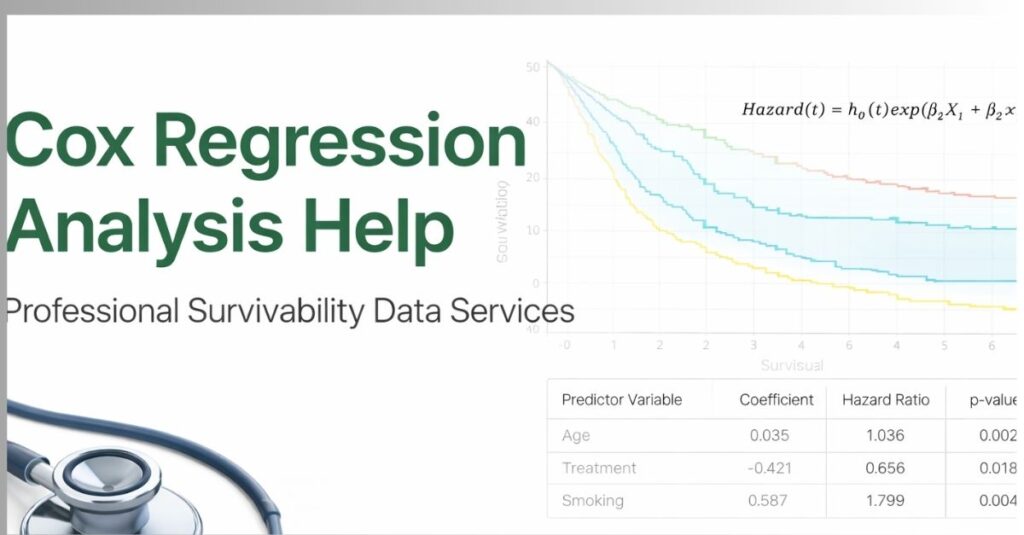
Cox Regression Analysis Help for Research and Professional Studies
Researchers widely use Cox regression analysis to examine time-to-event data. Researchers frequently encounter situations where the primary question is not simply whether an event occurs, but how long it takes for that event to occur under different conditions. For example, medical researchers often analyze the time until a patient relapses after treatment, engineers investigate how long machines operate before failure, and business analysts examine the duration before customers cancel subscriptions. In such situations, traditional statistical models like linear regression or logistic regression cannot properly address the time dimension or handle incomplete observations.
The Cox proportional hazards regression model was developed to address these challenges. It enables researchers to analyze survival time data while accounting for censoring and varying observation periods. The model estimates how different variables influence the hazard rate, which represents the probability that an event occurs at a given moment provided that it has not yet occurred. Because it does not require specifying the baseline hazard function, the Cox model offers flexibility that many other statistical techniques cannot provide. For full statistical support, you can also access our SPSS data analysis help and dissertation results help through SPSSDissertationHelp.com, where expert guidance ensures accurate interpretation and reporting.
At SPSS Dissertation Help, our statistical consultants assist researchers, analysts, and organizations in performing accurate Cox regression analysis using reliable statistical software. We ensure proper preparation of datasets, correct testing of assumptions, and clear interpretation of hazard ratios. The results are presented in professional tables and reports that support research conclusions and decision-making.
Request Quotes Now to receive expert assistance with Cox regression modeling for your research project.
Understanding the Cox Proportional Hazards Model
The Cox proportional hazards model evaluates the influence of independent variables on the hazard rate, which represents the risk that a particular event occurs at a specific time. Instead of predicting the exact timing of events, the model estimates relative risks between groups. These relative risks are expressed through hazard ratios, which indicate whether the likelihood of an event increases or decreases based on predictor variables.
In survival analysis, datasets frequently contain censored observations, meaning that the event of interest has not occurred for some participants during the study period. Cox regression properly incorporates these observations without discarding them, which helps preserve statistical power and ensures unbiased estimation.
The model is especially useful when multiple predictors influence the timing of an outcome. By including several independent variables simultaneously, Cox regression allows researchers to determine which factors significantly affect event occurrence while controlling for other influences. This ability makes the model extremely valuable in complex research settings where multiple variables interact to influence outcomes.
Example Dataset Used for Cox Regression Analysis
The table below illustrates a simplified example of survival data used for Cox regression modeling. In this example, a medical study investigates how different patient characteristics influence the time until disease recurrence.
| Patient ID | Survival Time (Months) | Event Occurred | Age | Treatment Group | Smoking Status |
|---|---|---|---|---|---|
| P001 | 12 | Yes | 58 | Drug A | Yes |
| P002 | 18 | No | 63 | Drug B | No |
| P003 | 9 | Yes | 55 | Drug A | Yes |
| P004 | 24 | No | 61 | Drug B | No |
| P005 | 15 | Yes | 60 | Drug A | No |
| P006 | 21 | Yes | 64 | Drug B | Yes |
| P007 | 10 | Yes | 59 | Drug A | Yes |
| P008 | 20 | No | 62 | Drug B | No |
In this dataset, survival time represents the duration between the beginning of the study and the occurrence of the event or censoring. The event variable indicates whether the outcome occurred during the study period. Predictor variables such as age, treatment type, and smoking status are included to evaluate their influence on survival outcomes. Cox regression uses this information to estimate the relationship between these variables and the hazard rate over time.
Cox Regression Model Results
After running Cox regression analysis using statistical software such as SPSS or R, the results are summarized in a table containing coefficients, hazard ratios, and statistical significance levels.
Cox Regression Output Table
| Predictor Variable | Coefficient (β) | Hazard Ratio | Standard Error | p-value |
|---|---|---|---|---|
| Age | 0.032 | 1.033 | 0.011 | 0.004 |
| Treatment (Drug B vs Drug A) | -0.421 | 0.656 | 0.173 | 0.015 |
| Smoking Status | 0.587 | 1.799 | 0.198 | 0.002 |
Interpretation of Results
The results show that age is positively associated with recurrence risk. The hazard ratio of 1.033 indicates that each additional year of age increases the risk of recurrence by approximately 3.3 percent. Although this increase may appear small, the effect becomes more meaningful when age differences accumulate across larger populations.
Treatment type also shows a statistically significant relationship with survival time. Patients receiving Drug B exhibit a hazard ratio of 0.656, suggesting that their recurrence risk is approximately 34 percent lower than patients treated with Drug A. This result indicates that Drug B may provide stronger protection against disease recurrence.
Smoking status demonstrates a strong effect. Smokers have a hazard ratio of 1.799, meaning their recurrence risk is almost 80 percent higher than non-smokers. This finding highlights smoking as an important risk factor influencing disease outcomes and suggests that smoking cessation programs could improve long-term survival outcomes.
Survival Probability Estimates
Researchers often estimate survival probabilities at different time intervals to understand how the likelihood of survival changes during the study period.
Estimated Survival Probabilities
| Time (Months) | Survival Probability |
|---|---|
| 6 | 0.92 |
| 12 | 0.81 |
| 18 | 0.72 |
| 24 | 0.65 |
These probabilities represent the proportion of individuals expected to remain event-free at each time point. For example, a survival probability of 0.81 at twelve months means that approximately 81 percent of participants remain free of recurrence after one year. By twenty-four months, the survival probability decreases to 0.65, meaning that about 65 percent of participants have not experienced the event.
Such survival estimates help researchers visualize patterns of risk before conducting more advanced regression modeling.
Testing the Proportional Hazards Assumption
One of the key assumptions of Cox regression analysis is the proportional hazards assumption. This assumption states that the hazard ratios between groups remain constant over time. If this assumption is violated, the model may produce biased or misleading results.
Researchers typically evaluate this assumption using statistical tests and diagnostic procedures.
Proportional Hazards Diagnostic Results
| Variable | Schoenfeld Residual Statistic | p-value | Interpretation |
|---|---|---|---|
| Age | 1.89 | 0.17 | Assumption satisfied |
| Treatment | 0.73 | 0.39 | Assumption satisfied |
| Smoking Status | 2.01 | 0.16 | Assumption satisfied |
Because all p-values are greater than 0.05, the proportional hazards assumption is satisfied for each predictor variable. This indicates that the hazard ratios remain stable over time and that the model results are statistically reliable.
Advantages of Cox Regression Analysis
Cox regression provides several advantages that make it particularly valuable for research and professional data analysis. One major advantage is its ability to handle censored observations. In many studies, some participants do not experience the event before the study ends, and removing these individuals from analysis would waste valuable information. Cox regression incorporates censored observations appropriately, ensuring that the dataset remains complete and statistically powerful.
Another important advantage is the ability to evaluate multiple predictors simultaneously. Many outcomes are influenced by several variables, and Cox regression allows researchers to isolate the effect of each factor while controlling for others. This capability improves the accuracy of conclusions and helps identify the true factors influencing survival outcomes.
The model also produces hazard ratios that provide intuitive interpretations of risk. Researchers can easily determine whether a variable increases or decreases event risk and quantify the magnitude of that effect.
Applications of Cox Regression Across Different Fields
Cox regression analysis is widely applied across many research disciplines because it helps evaluate how different factors influence the timing of events. In healthcare research, survival analysis helps investigators study patient survival after treatment, identify risk factors for disease progression, and evaluate the effectiveness of new therapies. These insights enable healthcare providers to design more effective treatment strategies.
In engineering reliability analysis, Cox regression helps engineers determine how environmental conditions, manufacturing differences, and usage patterns influence equipment lifespan. This information allows organizations to improve maintenance planning and increase product reliability.
In business analytics, survival models help analysts study customer churn, employee turnover, and subscription duration. By identifying factors that influence when customers cancel services or employees leave organizations, companies can develop strategies to improve long-term retention.
In social science research, survival analysis helps scholars study events such as career transitions, marriage timing, or educational completion. These analyses contribute to evidence-based policy decisions and a deeper understanding of social trends.
Professional Cox Regression Analysis Services
At SPSS Dissertation Help, we provide comprehensive support for survival analysis projects. Our statistical consultants assist with every stage of the analytical process, from preparing datasets to interpreting statistical outputs.
Our services include data cleaning and preparation, coding event and censoring variables, running Cox regression models in statistical software such as SPSS or R, testing model assumptions, interpreting hazard ratios and survival probabilities, and producing professional statistical tables and reports.
Each project is conducted by experienced statisticians who understand both the technical details and the practical implications of survival modeling.
Request Quotes Now if you require professional Cox regression analysis support for your research or data project.
Related Statistical Services
Researchers often combine Cox regression with other statistical techniques to obtain deeper insights from their datasets. Our platform provides additional services that complement survival analysis.
- Regression Analysis Help
- ANOVA Analysis Services
- Logistic Regression Analysis Help
- Meta Analysis Statistical Support
- Kaplan-Meier Survival Analysis Assistance
You can explore these services on our SPSS Dissertation Help
Combining multiple statistical techniques allows researchers to build more comprehensive and reliable analytical frameworks.
How to Run Cox Regression Analysis in SPSS
Running Cox regression analysis in SPSS requires proper dataset preparation and an understanding of survival analysis concepts. Researchers must ensure that the dataset contains a survival time variable, an event indicator variable, and independent variables expected to influence the timing of the event. These components allow the Cox proportional hazards model to estimate how predictors affect the risk of an event occurring over time.
The first step is defining the survival time variable. This variable measures the duration between the start of observation and the occurrence of the event. In medical research, this might represent the time from diagnosis to relapse, while in business analytics it could represent the time between a customer’s first purchase and subscription cancellation. Accurately measuring survival time is essential because the model analyzes how risk changes during the observation period.
The second step involves identifying the event indicator variable. This binary variable distinguishes between cases where the event occurred and those where the observation was censored. Typically, “1” indicates the event occurred and “0” indicates censoring.
Once the dataset is prepared, researchers open SPSS and select Analyze, then Survival, and Cox Regression. The time variable is placed in the time field, the event variable in the status field, and predictors as covariates. SPSS then estimates the model and produces tables with coefficients, hazard ratios, and significance levels.
Example SPSS Cox Regression Output
| Variable | B Coefficient | Hazard Ratio | Standard Error | Wald Statistic | p-value |
|---|---|---|---|---|---|
| Age | 0.041 | 1.042 | 0.012 | 11.67 | 0.001 |
| Treatment (Drug B) | -0.356 | 0.700 | 0.165 | 4.65 | 0.031 |
| Smoking | 0.628 | 1.874 | 0.210 | 8.94 | 0.003 |
The results above indicate that age and smoking significantly increase the hazard of the event, while Drug B reduces the risk compared with Drug A. Interpreting these outputs correctly is essential for drawing accurate research conclusions.
Researchers often require assistance interpreting statistical outputs and ensuring the model satisfies the required assumptions. Our experts at SPSS Dissertation Help provide professional support with survival analysis modeling and reporting.
Request Quotes Now if you need expert assistance running Cox regression analysis in SPSS.
Interpreting Hazard Ratios in Cox Regression
Understanding hazard ratios is essential when interpreting the results of Cox regression analysis. A hazard ratio measures the relative change in the hazard rate associated with a one-unit increase in a predictor variable. It represents the ratio of event risk between two groups at any given time during the study period.
If the hazard ratio is greater than one, the predictor increases the likelihood that the event will occur. If the hazard ratio is less than one, the predictor reduces the risk of the event. A hazard ratio equal to one indicates that the predictor has no effect on the hazard rate.
The magnitude of the hazard ratio determines the strength of the relationship between the predictor and the outcome. For example, a hazard ratio of 1.20 indicates a 20 percent increase in risk, while a hazard ratio of 0.80 represents a 20 percent reduction in risk.
Example Hazard Ratio Interpretation
| Predictor | Hazard Ratio | Interpretation |
|---|---|---|
| Age | 1.042 | Each additional year increases risk by 4.2% |
| Treatment B | 0.700 | Treatment B reduces risk by 30% |
| Smoking | 1.874 | Smokers have 87.4% higher risk |
These results demonstrate how hazard ratios provide clear insights into how predictor variables influence survival outcomes. In this example, smoking dramatically increases the risk of the event while Treatment B significantly reduces it.
Accurate interpretation requires careful consideration of confidence intervals, reference categories, and model assumptions. Our statistical consultants ensure that these elements are properly explained in research reports.
Kaplan-Meier Analysis vs Cox Regression
Kaplan-Meier analysis and Cox regression are both used in survival analysis, but they serve different purposes. This method is a non-parametric technique used to estimate survival probabilities over time for different groups.. It produces survival curves that visually represent the proportion of individuals who remain event-free at each time point.
Cox regression analysis extends survival analysis by incorporating multiple predictor variables simultaneously. Instead of simply estimating survival probabilities, it evaluates how different factors influence the hazard rate.
Comparison of Survival Analysis Methods
| Feature | Kaplan-Meier Analysis | Cox Regression |
|---|---|---|
| Purpose | Estimate survival probability | Examine predictors of survival |
| Variables | One grouping variable | Multiple predictor variables |
| Output | Survival curves | Hazard ratios |
| Model Type | Non-parametric | Semi-parametric |
| Complexity | Simple | Advanced statistical model |
Researchers often use Kaplan-Meier analysis to visualize survival patterns before performing Cox regression to identify the variables responsible for those patterns.
Common Mistakes in Cox Regression Analysis
Despite its usefulness, Cox regression analysis can produce misleading results if researchers make methodological errors. One of the most common mistakes is ignoring the proportional hazards assumption. This assumption requires that the hazard ratio between groups remains constant throughout the study period. If this assumption is violated, the model may not accurately represent the relationship between predictors and survival outcomes.
Another common error involves using datasets with insufficient events. Survival models require an adequate number of observed events to produce reliable hazard ratio estimates. When too few events occur, the regression coefficients may become unstable and the results may lack statistical power.
Multicollinearity among predictor variables is another potential issue. When independent variables are highly correlated, it becomes difficult to determine which variable is truly influencing the hazard rate. Researchers must examine correlation matrices and variance inflation factors to detect and resolve multicollinearity problems.
Improper coding of the event variable can also lead to serious errors. If censored observations are mistakenly coded as events, the hazard ratios will be distorted and the model will produce misleading conclusions.
Our consultants help researchers avoid these pitfalls by carefully examining datasets and verifying that the Cox regression model is correctly specified.
Request Quotes Now if you need assistance diagnosing Cox regression modeling errors.
Real Research Example of Cox Regression Analysis
Cox regression analysis is frequently used in healthcare research to identify risk factors affecting patient outcomes. Consider a study examining the time until hospital readmission following surgical procedures. Researchers collected data from 300 patients and evaluated whether age, smoking status, and treatment type influenced the likelihood of readmission.
Cox Regression Results from Clinical Study
| Variable | Hazard Ratio | 95% Confidence Interval | p-value |
|---|---|---|---|
| Age | 1.038 | 1.015 – 1.061 | 0.002 |
| Smoking | 1.652 | 1.210 – 2.255 | 0.001 |
| Treatment B | 0.712 | 0.520 – 0.975 | 0.033 |
The results show that smoking significantly increases the likelihood of hospital readmission, while Treatment B reduces the risk compared with the standard treatment. Age also contributes to a gradual increase in hazard.
These findings help healthcare providers identify high-risk patients and develop targeted strategies to reduce readmission rates.
Why Researchers Choose Our Cox Regression Services
Researchers choose SPSS Dissertation Help because our statistical consultants provide accurate survival analysis modeling and clear interpretation of results. Cox regression analysis can become technically complex when datasets include censored observations, multiple predictors, and time-dependent variables.
Our team provides complete support throughout the research process, including dataset preparation, model estimation, diagnostic testing, and interpretation of hazard ratios. We ensure that the model assumptions are satisfied and that results are presented in professional tables suitable for research publications.
Our services are trusted by researchers across multiple disciplines including medicine, engineering, business analytics, and social science research.
Request Quotes Now to receive professional Cox regression analysis support.
Related Statistical Analysis Services
Many research projects require multiple statistical techniques to fully understand complex datasets. In addition to Cox regression analysis, our platform offers a wide range of statistical consulting services.
- Regression Analysis Help
- ANOVA Analysis Services
- Logistic Regression Analysis Help
- Meta Analysis Statistical Support
- Kaplan-Meier Survival Analysis Assistance
These services are available on our website at:
Combining different statistical approaches allows researchers to obtain deeper insights from their data and produce more reliable results.
Frequently Asked Questions About Cox Regression Analysis
What is Cox regression analysis used for?
Cox regression analysis is used to examine time-to-event data and identify variables that influence the hazard rate. It is widely applied in medical research, engineering reliability studies, and business analytics.
What is a hazard ratio?
A hazard ratio represents the relative change in the risk of an event occurring when a predictor variable increases by one unit. Values greater than one indicate increased risk, while values less than one indicate reduced risk.
What is the proportional hazards assumption?
The proportional hazards assumption states that the hazard ratio between groups remains constant over time. This assumption must be satisfied for Cox regression results to be valid.
Can Cox regression handle censored data?
Yes. Cox regression is specifically designed to handle censored observations where the event has not occurred during the observation period.
What software can perform Cox regression analysis?
Common statistical software used for Cox regression includes SPSS, R, Stata, and SAS.
What sample size is required for Cox regression?
The required sample size depends on the number of predictor variables and the number of observed events. A general guideline is at least ten events per predictor variable.
How is Cox regression different from logistic regression?
Logistic regression predicts whether an event occurs, while Cox regression analyzes how long it takes for the event to occur.
When should Kaplan-Meier analysis be used?
Kaplan-Meier analysis is used to estimate survival probabilities for groups without adjusting for multiple predictors.
Why is Cox regression important in medical research?
Cox regression allows researchers to identify risk factors influencing survival time and evaluate treatment effectiveness.
Where can I get help with Cox regression analysis?
Professional assistance is available through SPSS Dissertation Help, where experienced statisticians assist with survival modeling and interpretation.