
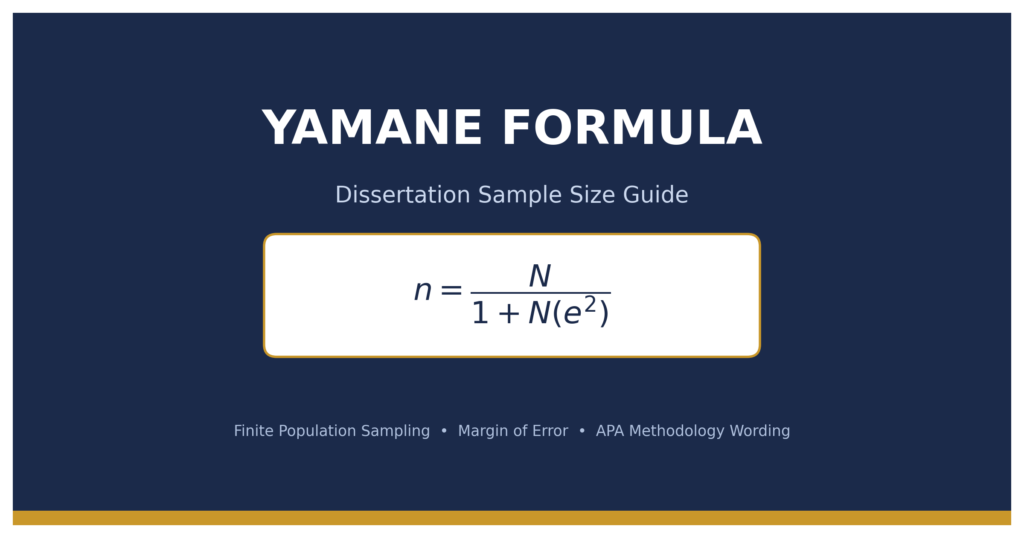
Choosing the right sample size is one of the first real methodology decisions a dissertation student has to defend, and it’s also one of the easiest to get wrong. If your population is known and finite, the Yamane formula is one of the most widely used tools for estimating how many participants you need. But knowing the formula isn’t the same as knowing how to apply it correctly, adjust it for real-world non-response, or write it up in a way your committee will accept.
This guide walks through the Yamane sample size formula from first principles: what it is, when it applies, a full worked example, a ready-to-use sample size table, non-response adjustment, and how it compares to Cochran’s formula, Slovin’s formula, and statistical power analysis. By the end, you’ll know exactly how to calculate your sample size and how to describe it in your methodology chapter.
What Is the Yamane Formula?
The Yamane formula, developed by statistician Taro Yamane, is used to estimate the minimum sample size needed when the total population is known and finite. It’s a staple in survey-based research across business studies, education, social sciences, public health, and dissertation methodology chapters, largely because it’s simple to compute and doesn’t require a prior estimate of population variability.
The formula is:
n = N / [1 + N(e²)]
| Symbol | Meaning |
|---|---|
| n | Required sample size |
| N | Total population size |
| e | Margin of error (precision level) |
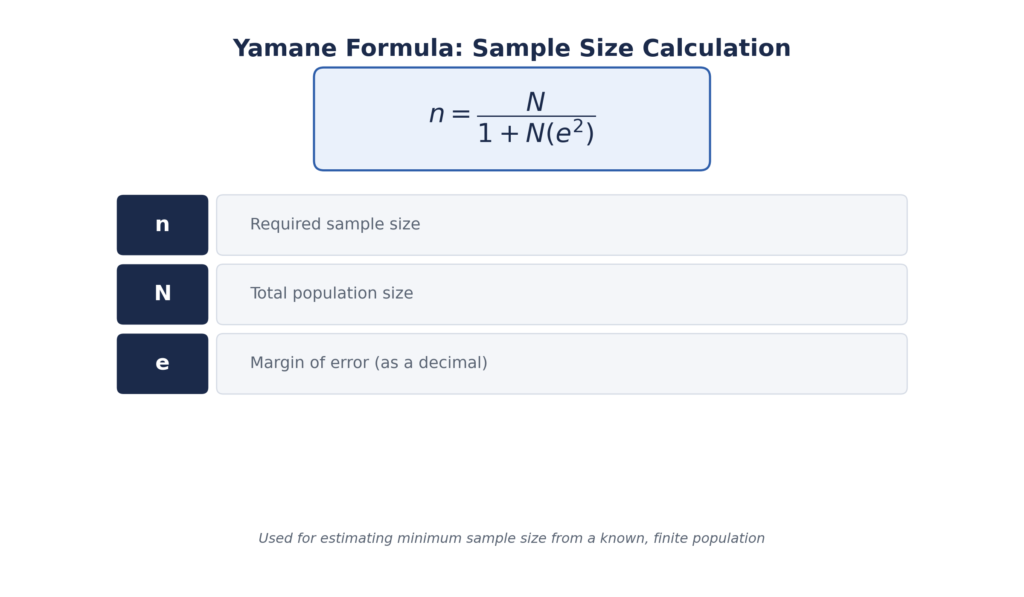
One detail trips up more students than any other: e must be entered as a decimal, not a percentage. A 5% margin of error is written as 0.05, not 5. Get this wrong and your sample size calculation will be off by orders of magnitude.
When Should You Use the Yamane Formula?
The Yamane formula is a good fit when:
- The population size is known
- The population is finite (not an open-ended or unknown group)
- You’re using probability sampling
- Your study is survey-based
- The goal is to estimate a sample for descriptive or proportion-based research
- You don’t have a prior estimate of population variability to work with
It’s not always sufficient, though. You’ll likely need something more than the Yamane formula if:
- Your study requires formal statistical power analysis
- You’re comparing experimental or control groups
- Your sampling design is complex (stratified, clustered, multi-stage)
- Your outcome variable is rare
- You have many predictor variables in a regression model
- Your dissertation committee specifically requires a power-based justification (commonly via G*Power)
If any of those apply, it’s worth talking to your committee before committing to Yamane’s formula as your sole justification. See our power analysis help page if that’s the direction your study needs to go.
How to Calculate Sample Size Using the Yamane Formula
Follow these steps in order:
- Identify your population size (N).
- Choose your margin of error (commonly 5%, sometimes 3% or 10%).
- Convert the margin of error to a decimal (5% → 0.05).
- Square the margin of error.
- Multiply the squared margin of error by the population size.
- Add 1 to that result.
- Divide the population size by the result from step 6.
- Round up to the nearest whole number. You can’t recruit a fractional participant.
Yamane Formula Example With a 5% Margin of Error
Let’s work through a concrete example.
Given: N = 1,000 e = 0.05
Calculation:
n = 1000 / [1 + 1000(0.05²)] n = 1000 / [1 + 1000(0.0025)] n = 1000 / [1 + 2.5] n = 1000 / 3.5 n = 285.71
Required sample size = 286
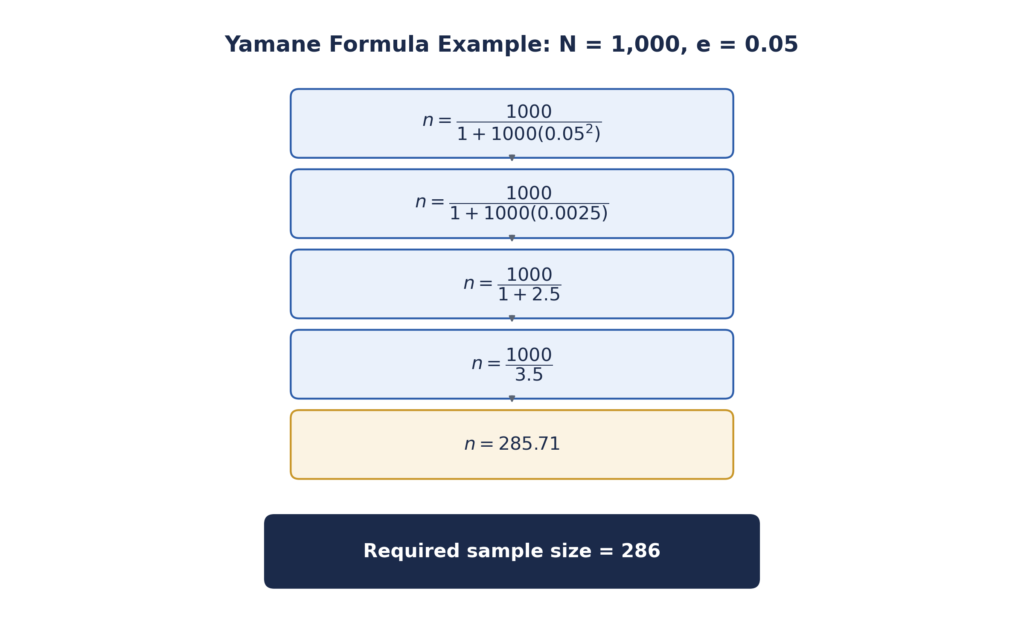
That 286 is your minimum. It assumes every single person you approach responds. In practice, you should plan to recruit more than 286 to account for non-response, which we’ll cover shortly.
Yamane Formula Sample Size Table
For a quick reference, here’s the minimum sample size at a 5% margin of error across common population sizes, along with a recommended recruitment target assuming a 10% non-response rate.
| Population Size | Margin of Error | Minimum Sample Size | Recommended Sample (10% Non-Response Allowance) |
|---|---|---|---|
| 100 | 5% | 80 | 89 |
| 200 | 5% | 133 | 148 |
| 500 | 5% | 222 | 247 |
| 1,000 | 5% | 286 | 318 |
| 2,000 | 5% | 333 | 370 |
| 5,000 | 5% | 370 | 411 |
| 10,000 | 5% | 385 | 428 |
| 50,000 | 5% | 397 | 441 |
| 100,000 | 5% | 398 | 443 |
Notice how the minimum sample size plateaus as the population grows. This is a well-known property of the formula and a useful point to mention if your committee questions why a population of 100,000 doesn’t require a proportionally larger sample than one of 10,000.
How to Adjust the Yamane Formula for Non-Response
The Yamane formula tells you the minimum number of usable responses you need. It says nothing about how many people to approach. Real studies lose participants to non-response, incomplete questionnaires, missing data, and invalid submissions. If you only recruit exactly the minimum, you’ll likely fall short.
The adjustment is straightforward:
Adjusted sample size = Required sample size / Expected response rate
Example: If your required sample size is 286 and you expect an 80% response rate:
286 / 0.80 = 357.5
Recommended recruitment target = 358
Always state your assumed response rate in your methodology chapter, and base it on prior studies in your field where possible rather than guessing.
Yamane Formula in Research Methodology
Committees expect a clear, specific paragraph tying your numbers together. Here’s a template:
“The sample size was estimated using Yamane’s formula for finite populations. The target population consisted of 1,000 eligible participants. Using a margin of error of 5% and assuming a 95% confidence level, the minimum required sample size was calculated as 286. To account for possible non-response or incomplete questionnaires, the recruitment target was increased to 358.”
Common Mistakes When Using the Yamane Formula
Watch out for these, since they’re the most frequent reasons committees send methodology chapters back for revision:
- Entering 5 instead of 0.05 for the margin of error
- Using the formula when the population size is genuinely unknown
- Forgetting to round the final sample size up
- Treating the Yamane formula as a substitute for statistical power analysis
- Ignoring non-response and recruiting only the bare minimum
- Failing to explain the sampling method alongside the sample size
- Applying Yamane’s formula to every research design without justifying the choice
- Confusing sample size (how many) with sampling technique (how you select them)
Yamane Formula vs Slovin Formula
Yamane’s and Slovin’s formulas are frequently presented in nearly identical form, and the two names are sometimes used interchangeably in different academic traditions. Practically speaking, the distinction matters less than consistency: use whichever term your institution or field prefers, cite it correctly, and be ready to justify the assumptions behind it: a known finite population and an accepted margin of error.
Yamane Formula vs Cochran Formula
Cochran’s formula is typically used for estimating sample size based on proportions, and can be adjusted for finite populations using a correction factor. Compared to Yamane’s formula, Cochran’s approach allows more explicit input of confidence level, an estimated population proportion, and margin of error. This makes it more flexible but also more demanding in terms of what you need to know or assume in advance. Yamane’s formula remains the simpler, faster option when a rough estimate of proportion isn’t available.
Yamane Formula vs Power Analysis
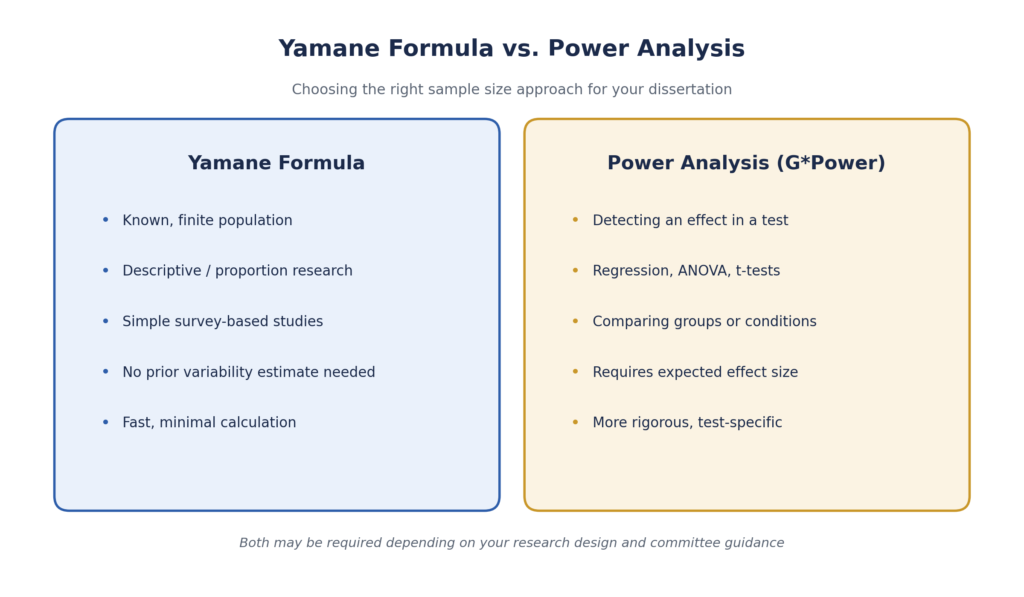
These two are often confused but answer different questions. Yamane’s formula estimates the sample size needed to represent a known, finite population within a given margin of error. Statistical power analysis estimates the sample size needed to reliably detect a specific effect size in a statistical test. If your dissertation involves regression, ANOVA, t-tests, mediation, or moderation, a power-based justification is usually more appropriate. See our power analysis help and G*Power analysis help pages for that process.
Can You Use the Yamane Formula With SPSS?
Not directly. The Yamane formula is used before data collection to plan your sample, while SPSS is used after data collection to analyze it. Once your data is in, SPSS can help you confirm whether your final usable sample (after excluding incomplete or invalid responses) still meets your planned target. For the analysis stage itself, see our SPSS data analysis help page.
Need Help Justifying Your Sample Size?
Getting your sample size right, and being able to defend it, is one of the most scrutinized parts of Chapter 3. If you’re unsure whether the Yamane formula fits your design, need help adjusting for non-response, or want a second opinion before you submit, send us your population size, margin of error, and sampling method. We’ll help you confirm the right approach and write it up clearly. For broader statistical support across your dissertation, visit our dissertation statistics help page.
Frequently Asked Questions About the Yamane Formula
It’s a formula used to estimate the minimum sample size needed for a known, finite population, given a chosen margin of error.
n = N / [1 + N(e²)], where N is the population size and e is the margin of error expressed as a decimal.
Use it when your population is known and finite, you’re using probability sampling, and your study is survey-based without a need for formal power analysis.
e is the margin of error, or acceptable level of precision, expressed as a decimal (5% = 0.05).
Yes. 5% written as a decimal is 0.05, and this is the value you enter into the formula.
Yes, it’s commonly accepted for survey-based dissertations with a known finite population, though you should confirm with your supervisor or committee whether it fits your specific design.
They are presented in nearly identical mathematical form and are often used interchangeably, though naming conventions vary by institution and field.
Yamane’s formula estimates sample size for a known finite population; power analysis estimates the sample needed to detect a statistical effect. See our power analysis help page for more on the latter.
SPSS isn’t typically used to calculate the Yamane formula itself, since that’s a pre-data-collection planning step, but it’s used afterward to analyze the collected data. See SPSS data analysis help.
Yes. The formula gives you a minimum required sample; you should divide that by your expected response rate to determine how many participants to actually recruit.
Conclusion
The Yamane formula is a practical, well-established tool for estimating sample size when your population is known and finite, but it’s not a one-size-fits-all solution. Knowing when it applies, how to adjust it for non-response, and how it differs from Cochran’s formula, Slovin’s formula, and power analysis will make your methodology chapter far more defensible. Always confirm with your supervisor or committee that the Yamane formula is the appropriate method for your specific research design before finalizing your sample size.
If you need a second opinion on your sample size calculation or help writing up your methodology section, send us your population size, margin of error, and sampling approach. We’re happy to help you get it right.
