How to Interpret Correlation Results in SPSS (Complete Guide for Students)
Interpreting correlation results in SPSS is one of the most misunderstood steps in statistical analysis. While many students can run a correlation test successfully, far fewer can explain what the results actually mean in clear academic language. Misinterpreting correlation output can lead to incorrect conclusions, weak discussion sections, and lost marks in assignments, theses, and dissertations.
This guide focuses only on how to interpret correlation results in SPSS, not how to run the test. If you are looking for a full explanation of correlation analysis, assumptions, and SPSS procedures, see our complete guide on Correlation Analysis in SPSS.
By the end of this article, you will be able to confidently interpret correlation output, explain results in plain academic language, and report findings correctly in APA style.
What Does “Interpreting Correlation Results” Mean?
Interpreting correlation results means explaining:
- Whether a relationship exists between variables
- The direction of the relationship
- The strength of the relationship
- Whether the relationship is statistically significant
- What the relationship means in the context of your research
Interpretation goes beyond stating numbers. Examiners expect you to explain what the results imply for your research question, theory, or hypothesis.
Understanding the SPSS Correlation Output Table
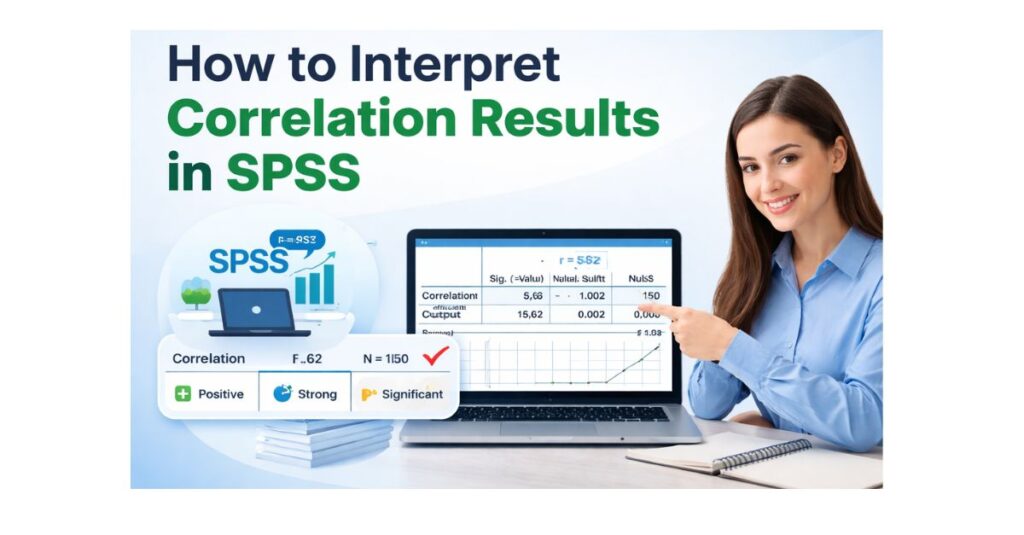
When SPSS produces correlation results, they are typically presented in a correlation matrix. This table contains several key components that must be interpreted together.
Key Elements in the SPSS Correlation Table
Each cell in the table usually includes:
- The correlation coefficient (e.g., Pearson’s r or Spearman’s rho)
- The significance value (p-value)
- The sample size (N)
Correct interpretation requires reading all three values, not just the correlation coefficient alone.
Interpreting the Correlation Coefficient (r or ρ)
The correlation coefficient tells you how strongly and in what direction two variables are related.
Direction of the Relationship
- Positive correlation: As one variable increases, the other also increases
- Negative correlation: As one variable increases, the other decreases
- Zero correlation: No linear relationship between the variables
Always state the direction clearly in words, not just with a sign.
Strength of the Relationship
Although interpretation varies slightly by discipline, the following guidelines are widely accepted:
- 0.00–0.29 → Weak relationship
- 0.30–0.49 → Moderate relationship
- 0.50–0.69 → Strong relationship
- 0.70–1.00 → Very strong relationship
You should interpret strength in context, especially in social sciences where moderate correlations are common and meaningful.
Interpreting Statistical Significance (p-value)
The p-value indicates whether the observed correlation is statistically significant.
How to Interpret the p-value
- p < .05 → The correlation is statistically significant
- p ≥ .05 → The correlation is not statistically significant
A statistically significant correlation means the relationship is unlikely to have occurred by chance, not that it is important or large.
Statistical Significance vs Practical Importance
A common student mistake is equating statistical significance with importance.
- Large samples can produce significant but weak correlations
- Small samples can produce strong but non-significant correlations
Your interpretation should address both significance and strength, not one alone.
Interpreting Correlation Results in Words (Academic Style)
A high-quality interpretation includes:
- Type of correlation used
- Direction of the relationship
- Strength of the relationship
- Statistical significance
- Meaning in relation to the research question
Example Interpretation
There was a moderate positive correlation between study time and exam performance, indicating that higher study time was associated with higher exam scores. This relationship was statistically significant, suggesting a meaningful association between the variables.
Notice that this interpretation explains the result without restating numbers mechanically.
Interpreting Correlation Matrices with Multiple Variables
When multiple variables are included, SPSS displays a full correlation matrix.
How to Interpret a Correlation Matrix Correctly
- Focus only on relationships relevant to your research questions
- Avoid interpreting every correlation in the table
- Identify patterns rather than isolated coefficients
- Watch for very high correlations that may suggest overlap between variables
Correlation matrices are often used as a preliminary step before more advanced analysis such as regression.
Interpreting Non-Significant Correlations
A non-significant correlation does not mean the analysis failed. It simply indicates that there is insufficient evidence of a relationship in the sample.
How to Interpret Non-Significant Results
- State that no statistically significant relationship was found
- Avoid implying absence of any relationship in the population
- Discuss possible reasons (sample size, measurement issues, variability)
Clear interpretation of non-significant findings demonstrates strong analytical maturity.
Common Mistakes Students Make When Interpreting Correlation Results
Many students lose marks due to avoidable interpretation errors.
Frequent Interpretation Errors
- Saying correlation proves causation
- Ignoring the direction of the relationship
- Reporting p-values without explaining strength
- Overinterpreting weak correlations
- Failing to link results back to research questions
Avoiding these mistakes strengthens both your results and discussion sections.
Reporting Correlation Results in APA Style
While this article focuses on interpretation, results must also be reported correctly.
A proper APA-style report includes:
- Type of correlation
- Correlation coefficient
- Degrees of freedom (if required)
- p-value
For a full reporting guide, see our article on How to Report SPSS Results in APA Format.
Correlation Interpretation vs Regression Interpretation
Correlation interpretation focuses on association, while regression interpretation focuses on prediction.
Key differences:
- Correlation treats variables equally
- Regression distinguishes dependent and independent variables
- Correlation does not explain variance or causality
Understanding this distinction prevents misuse of correlation results in dissertations.
Using Correlation Interpretation in Dissertations and Theses
In academic research, correlation interpretation is commonly used to:
- Address relational research questions
- Support theoretical relationships
- Justify further statistical analysis
- Provide empirical evidence in literature discussions
Clear interpretation strengthens examiner confidence in your analytical skills.
When to Seek Expert Help Interpreting Correlation Results
If you are unsure how to interpret your SPSS output or explain findings academically, expert guidance can prevent costly mistakes.
Professional SPSS data analysis help can ensure:
- Accurate interpretation
- Correct academic language
- APA-compliant reporting
- Strong dissertation-ready explanations
If you need support at any stage, you can Contact Us for confidential SPSS assistance.
Final Thoughts
Interpreting correlation results in SPSS is a skill that goes far beyond reading numbers from an output table. It requires understanding direction, strength, significance, and academic meaning. Mastering this skill allows you to explain relationships clearly, defend your findings confidently, and produce higher-quality academic work.
By focusing on interpretation rather than mechanics, you move from simply using SPSS to truly understanding your data—an essential step toward dissertation-level research excellence.