
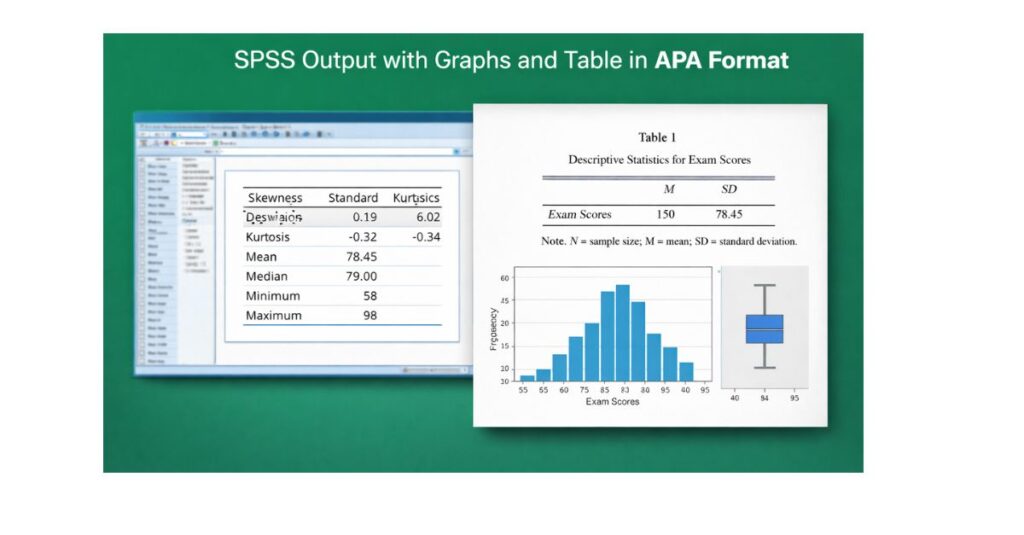
How to Interpret Descriptive Statistics in SPSS | Complete Step-by-Step Guide
Descriptive statistics form the core foundation of all quantitative research and statistical analysis. Before researchers test hypotheses, build regression models, or examine mediation and moderation effects, they must first understand the basic structure and behavior of their data. This is where descriptive statistics play a critical role.
In SPSS, descriptive statistics are often the first output generated, yet they are frequently misunderstood or poorly interpreted by students. Many learners focus only on obtaining p-values from inferential tests, ignoring the importance of understanding means, variability, and distribution shape. This approach leads to incorrect test selection, violated assumptions, and weak academic writing.
Descriptive statistics help researchers summarize large datasets into meaningful numerical values that describe:
- The typical or average score
- How much variability exists among participants
- Whether the data follows a normal distribution
- Whether outliers or anomalies may distort results
A strong understanding of descriptive statistics allows students to justify their analytical decisions, write clearer results sections, and defend their findings confidently in assignments, dissertations, and viva examinations.
What Are Descriptive Statistics?
Descriptive statistics are numerical measures used to summarize and organize data without making generalizations beyond the sample. Unlike inferential statistics, descriptive statistics do not test hypotheses or estimate population parameters. Instead, they provide a clear snapshot of the dataset as it exists.
In academic research, descriptive statistics are used to:
- Describe participant characteristics
- Summarize survey responses
- Evaluate data quality
- Support assumption testing
- Provide context for inferential analysis
In SPSS, descriptive statistics are typically generated using tools such as:
- Descriptives (for scale variables)
- Frequencies (for categorical variables)
- Explore (for advanced summaries and normality testing)
These outputs are required in nearly all quantitative research papers, dissertations, and theses, regardless of discipline.
Types of Descriptive Statistics
Descriptive statistics are commonly divided into three major categories, each answering a different research question about the data.
Measures of Central Tendency
Mean (Arithmetic Average)
The mean is calculated by summing all values and dividing by the number of observations. It is the most widely reported measure of central tendency in academic research.
Why the mean matters:
- Represents the overall level of the variable
- Useful for normally distributed data
- Commonly required in APA reporting
- Forms the basis for many inferential tests
Limitations of the mean:
- Highly sensitive to extreme values
- Can be misleading in skewed distributions
Academic interpretation example:
The mean satisfaction score was 4.21, indicating that participants generally reported high levels ofsatisfaction.
Median (Central Position)
The median represents the middle value when all scores are ordered from lowest to highest.
Why the median is important:
- Resistant to outliers
- Better representation for skewed data
- Commonly used for income, response time, and ordinal data
Interpretation guidance:
If the median differs substantially from the mean, the distribution is likely skewed.
Example:
The median monthly income was $3,200, indicating that half of the respondents earned less than this amount.
Mode (Most Frequent Value)
The mode identifies the most frequently occurring value in a dataset.
When the mode is most useful:
- Categorical variables (e.g., gender, marital status)
- Identifying dominant responses
- Nominal-level data
Example:
The most frequently reported employment status was full-time.
Measures of Variability
Standard Deviation (SD)
Standard deviation quantifies the average distance of scores from the mean.
Why SD is essential:
- Indicates consistency or diversity in responses
- Helps assess reliability of measurements
- Used in APA reporting
- Required for effect size interpretation
Interpretation framework:
- Small SD → responses are similar
- Large SD → responses vary widely
Academic example:
Participants reported a mean anxiety score of 29.4 (SD = 6.8), indicating moderate variability.
Variance
Variance represents the squared deviation from the mean.
Why variance matters:
- Foundation for ANOVA and regression
- Used internally by SPSS calculations
- Rarely interpreted directly in written reports
Range
The range shows the span of the dataset.
Why range is useful:
- Identifies extreme values
- Highlights potential outliers
- Provides context for variability
Example:
Scores ranged from 12 to 68, suggesting a wide distribution of responses.
Measures of Distribution Shape
Skewness
Skewness describes the direction and degree of asymmetry.
Interpretation rules in SPSS:
- –1 to +1 → approximately normal
- Beyond ±1 → skewed distribution
Why skewness matters:
- Affects test selection
- Influences interpretation of the mean
- Impacts assumption testing
Example:
The distribution showed positive skewness, indicating that most scores clustered at the lower end.
Kurtosis
Kurtosis measures the peakedness or flatness of the distribution.
Interpretation guidelines:
- Near zero → normal
- High positive → peaked
- Negative → flat
Academic relevance:
Extreme kurtosis can signal assumption violations for parametric tests.
How to Interpret Descriptive Statistics Output in SPSS
Step 1: Evaluate Sample Size (N)
Always confirm the number of valid cases. Missing data can distort results and reduce statistical power.
Step 2: Compare Mean and Median
Close values suggest symmetry; large gaps indicate skewness.
Step 3: Assess Variability
Interpret standard deviation relative to the mean to understand consistency.
Step 4: Review Skewness and Kurtosis
Ensure values fall within acceptable limits before proceeding to inferential tests.
APA Style Reporting of Descriptive Statistics
Correct APA Sentence Structure
The mean stress score was 23.8 (SD = 5.4).
Common APA Errors to Avoid
- Reporting SD without mean
- Using excessive decimals
- Inconsistent formatting
Importance of Descriptive Statistics Before Inferential Analysis
Descriptive statistics:
- Prevent incorrect test selection
- Identify assumption violations
- Improve research transparency
- Strengthen academic credibility
Skipping descriptive analysis is one of the most common reasons students lose marks.
Common Student Mistakes
- Ignoring missing data
- Misinterpreting skewness
- Reporting only means
- Copying SPSS tables without explanation
- Using mean instead of median for skewed data
Get Expert Help Interpreting Descriptive Statistics in SPSS
At SPSSDissertationHelp.com, we provide:
- SPSS assignment help
- Results interpretation support
- APA-formatted reporting
- Dissertation data analysis