
A patent validity analysis determines whether an issued patent can legally withstand a legal or administrative challenge. Whether you’re a researcher writing a dissertation on intellectual property, a startup evaluating freedom-to-operate risk, or a legal professional preparing for litigation, understanding this process is essential.
What Is Patent Validity?
A patent is presumed valid once granted, but that presumption can be rebutted. A patent is considered invalid if it fails to meet the legal requirements for patentability, most commonly novelty, non-obviousness (inventive step), and adequate disclosure (enablement and written description). Validity analysis is the systematic process of testing a patent’s claims against these requirements.
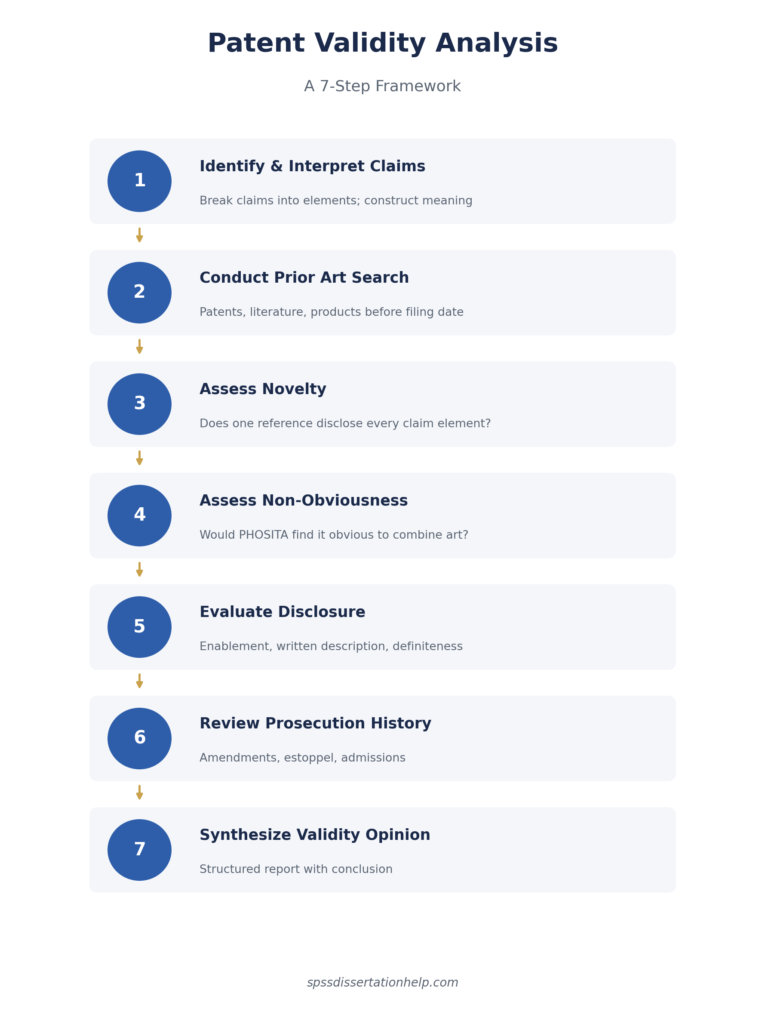
Step 1: Identify and Interpret the Claims
Validity is assessed claim-by-claim, not for the patent as a whole.
- Locate the independent claims. These define the broadest scope of protection and are the primary targets of a validity challenge.
- Perform claim construction. Determine the plain and ordinary meaning of each claim term, referring to the specification, prosecution history, and relevant case law or examination guidelines.
- Break claims into elements. Decompose each claim into individual limitations, since novelty and obviousness are assessed element by element.
Step 2: Conduct a Prior Art Search
This is the evidentiary foundation of the analysis.
- Search patent databases (e.g., USPTO, EPO Espacenet, WIPO PATENTSCOPE, Google Patents) for earlier patents and published applications.
- Search non-patent literature: academic journals, conference proceedings, technical manuals, product datasheets, and publicly available product samples.
- Check filing and priority dates. Only references published or publicly available before the patent’s effective filing date qualify as prior art.
- Document each reference with publication date, source, and a mapping to claim elements.
Step 3: Assess Novelty (Anticipation)
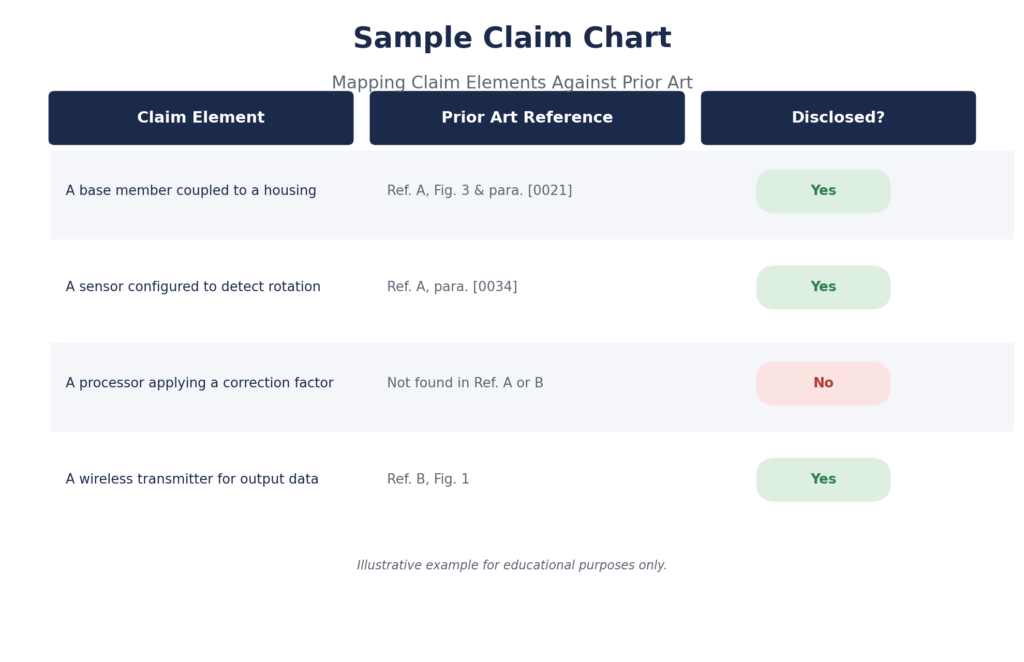
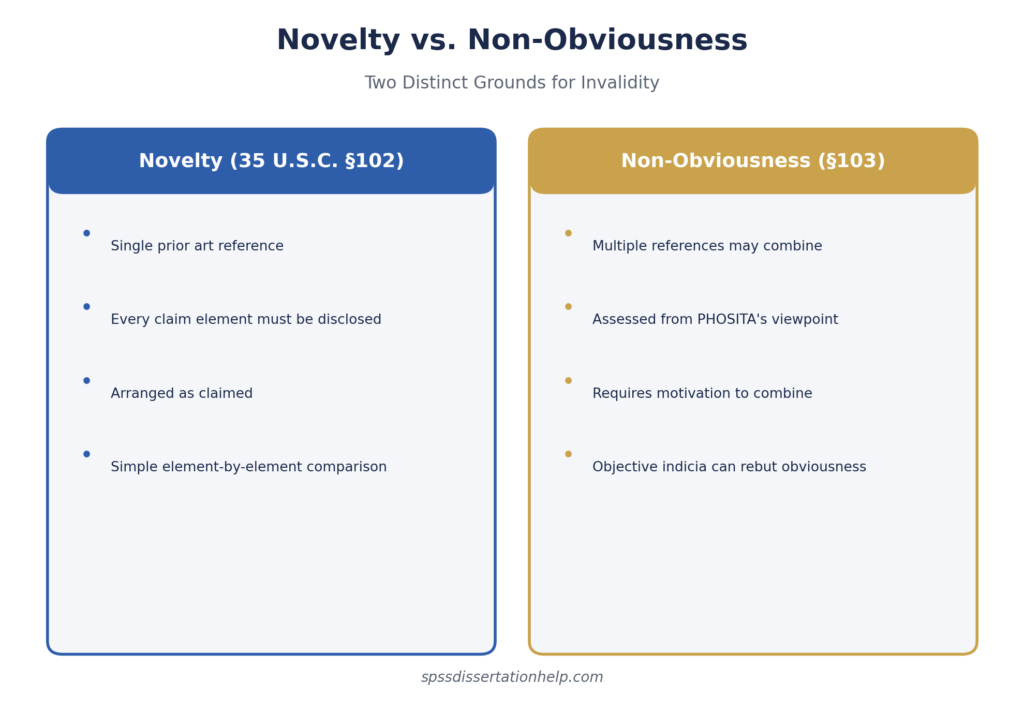
A claim lacks novelty if a single prior art reference discloses every element of the claim, arranged as claimed.
- Create a claim chart comparing each claim limitation against the disclosure of the closest single reference.
- If every element is found, expressly or inherently, in one reference, the claim is anticipated and invalid on that ground.
Step 4: Assess Non-Obviousness (Inventive Step)
Even if no single reference anticipates the claim, it may still be invalid if the claimed invention would have been obvious to a person having ordinary skill in the art (PHOSITA) at the time of filing.
- Identify the closest prior art and the differences between it and the claimed invention.
- Determine the level of ordinary skill in the relevant field.
- Assess whether there was motivation, suggestion, or reason to combine multiple references.
- Consider secondary (objective) indicia of non-obviousness, such as commercial success, long-felt but unsolved need, failure of others, and unexpected results.
Step 5: Evaluate Disclosure Requirements
A patent can also be invalidated on grounds unrelated to prior art:
- Enablement: Does the specification teach a person of ordinary skill how to make and use the full scope of the claimed invention without undue experimentation?
- Written description: Does the specification demonstrate that the inventor possessed the claimed invention at the time of filing?
- Definiteness: Are the claims reasonably clear in scope, or are they indefinite?
- Subject matter eligibility: Does the claim fall within a statutorily eligible category (particularly relevant for software, business methods, and biotech)?
Step 6: Review Prosecution History
Examine the file wrapper (prosecution history) at the relevant patent office:
- Look for arguments or amendments made to overcome prior art rejections, which may create prosecution history estoppel and narrow claim scope.
- Identify admissions about the state of the art.
- Check for procedural irregularities, such as inequitable conduct or failure to disclose known material prior art.
Step 7: Synthesize Findings into a Validity Opinion
Compile the analysis into a structured report that typically includes:
- Summary of the patent and claims analyzed
- Claim construction rationale
- Prior art search methodology and results
- Claim charts mapping prior art to claim elements
- Novelty and obviousness analysis
- Disclosure and eligibility analysis
- Overall conclusion with a confidence assessment (e.g., “likely invalid,” “reasonable validity challenge exists,” “likely to withstand challenge”)
Practical Tips
- Use claim charts consistently: they make the analysis transparent and are the standard format expected by examiners, courts, and academic reviewers.
- Track jurisdictional differences: validity standards differ between, for example, the U.S. (35 U.S.C. §§ 102, 103, 112), Europe (EPC Articles 54, 56, 83), and other regions.
- Cite primary sources: statutes, regulations, and case law should be cited directly rather than through secondary summaries.
- Be explicit about limitations: note where prior art searches may be incomplete or claim construction is disputed, since these affect the confidence of conclusions.
Conclusion
A rigorous patent validity analysis combines careful claim construction, thorough prior art research, and structured application of novelty, obviousness, and disclosure standards. For dissertation or research purposes, pairing this analytical framework with well-documented case studies and comparative data, such as invalidation rates by technology sector or jurisdiction, can strengthen the academic contribution of the work.
Published by SPSS Dissertation Help · For research and educational purposes. This article does not constitute legal advice.
