How to Reverse Code in SPSS
How to reverse code in SPSS is an important skill when working with Likert scale surveys, dissertation questionnaires, psychology scales, education research instruments, nursing surveys, business studies, and social science datasets. Reverse coding helps make sure that all items in a scale move in the same direction before you calculate totals, means, reliability, correlations, regressions, or other statistical tests.
In many questionnaires, some items are written positively while others are written negatively. For example, one item may say, “I feel confident completing my dissertation analysis,” while another may say, “I feel overwhelmed by statistical analysis.” If both items measure the same construct, the negatively worded item must often be reverse coded before analysis. Without this step, the final scale score can become misleading.
If you need expert support with data preparation, questionnaire coding, reliability testing, or interpretation, you can visit SPSS Dissertation Help or place your request through Request Quotes Now.
What Reverse Coding Means in SPSS
Reverse coding in SPSS means changing the values of a variable so that the direction of the scale is reversed. A low score becomes a high score, and a high score becomes a low score.
For example, in a 5-point Likert scale:
| Original Value | Original Meaning | Reverse Coded Value | Reverse Meaning |
|---|---|---|---|
| 1 | Strongly Disagree | 5 | Strongly Agree |
| 2 | Disagree | 4 | Agree |
| 3 | Neutral | 3 | Neutral |
| 4 | Agree | 2 | Disagree |
| 5 | Strongly Agree | 1 | Strongly Disagree |
The middle value stays the same because it is neutral. The outer values switch places.
Reverse coding is common when survey items are worded in opposite directions. It helps create consistent scores before running reliability analysis, descriptive statistics, correlation, regression, factor analysis, or dissertation results.
For broader help with statistical preparation and interpretation, you can also visit SPSS Data Analysis Help.
Why Reverse Coding Is Important in Dissertation Research
Reverse coding protects the accuracy of your results. When negatively worded items are not reversed, the scale can produce weak reliability, incorrect means, misleading correlations, and poor regression results.
For example, assume a student has a motivation scale with six items. Five items are positively worded, but one item is negatively worded:
| Item | Statement | Direction |
|---|---|---|
| Q1 | I feel motivated to complete my dissertation. | Positive |
| Q2 | I enjoy working on research tasks. | Positive |
| Q3 | I avoid dissertation work whenever possible. | Negative |
| Q4 | I feel confident about my academic progress. | Positive |
| Q5 | I can manage my research workload. | Positive |
| Q6 | I believe I can complete my dissertation successfully. | Positive |
Q3 must be reverse coded before creating a total or mean motivation score. If Q3 is left unchanged, high motivation on the other items may be mixed with low motivation on Q3, weakening the final scale.
When You Should Reverse Code Variables in SPSS
You should reverse code a variable when the item is worded in the opposite direction from the construct being measured.
Common signs include words such as:
| Wording Pattern | Example |
|---|---|
| Negative wording | “I do not feel confident using SPSS.” |
| Avoidance wording | “I try to avoid statistical analysis.” |
| Low-ability wording | “I struggle to understand research results.” |
| Opposite construct wording | “The service was confusing and unhelpful.” |
| Reverse attitude wording | “I would not recommend this program.” |
Reverse coding is often needed in scales measuring:
| Research Area | Common Construct |
|---|---|
| Psychology | anxiety, motivation, stress, self-efficacy |
| Education | learning confidence, engagement, satisfaction |
| Nursing | patient satisfaction, treatment perception, health behavior |
| Business | service quality, customer loyalty, employee engagement |
| Social science | attitudes, beliefs, behavior, participation |
Reverse Coding vs Recoding Variables in SPSS
Reverse coding is a specific type of recoding. Recoding simply means changing values from one form to another. Reverse coding changes values in the opposite direction of the original scale.
| Task | Purpose | Example |
|---|---|---|
| Reverse coding | Reverse the direction of a scale item | 1 becomes 5, 2 becomes 4 |
| General recoding | Group or change values | Age groups: 18–24, 25–34 |
| Compute variable | Create a new variable using a formula | Mean score from Q1 to Q5 |
| Transform variable | Broader data preparation process | Recode, compute, standardize, rank |
For related work, you can read How to Recode Variables in SPSS and How to Transform Variables in SPSS.
Best Method: Recode Into Different Variables
The safest method is Recode into Different Variables. This keeps the original variable unchanged and creates a new reversed version. This is usually better for dissertation work because it protects the raw data.
Example Dataset
Assume you have a 5-point Likert item:
Q3: I avoid working on my dissertation whenever possible.
| Response | Meaning |
|---|---|
| 1 | Strongly Disagree |
| 2 | Disagree |
| 3 | Neutral |
| 4 | Agree |
| 5 | Strongly Agree |
Because the item is negatively worded, higher scores mean lower motivation. If your scale measures motivation, Q3 should be reversed.
Reverse Coding Table
| Old Value | New Value |
|---|---|
| 1 | 5 |
| 2 | 4 |
| 3 | 3 |
| 4 | 2 |
| 5 | 1 |
Steps to Reverse Code in SPSS
| Step | Action in SPSS | Purpose |
|---|---|---|
| 1 | Click Transform | Opens data transformation options |
| 2 | Choose Recode into Different Variables | Creates a new reversed variable |
| 3 | Move the original variable into the input box | Selects the item to reverse |
| 4 | Name the new variable | Keeps the reversed version separate |
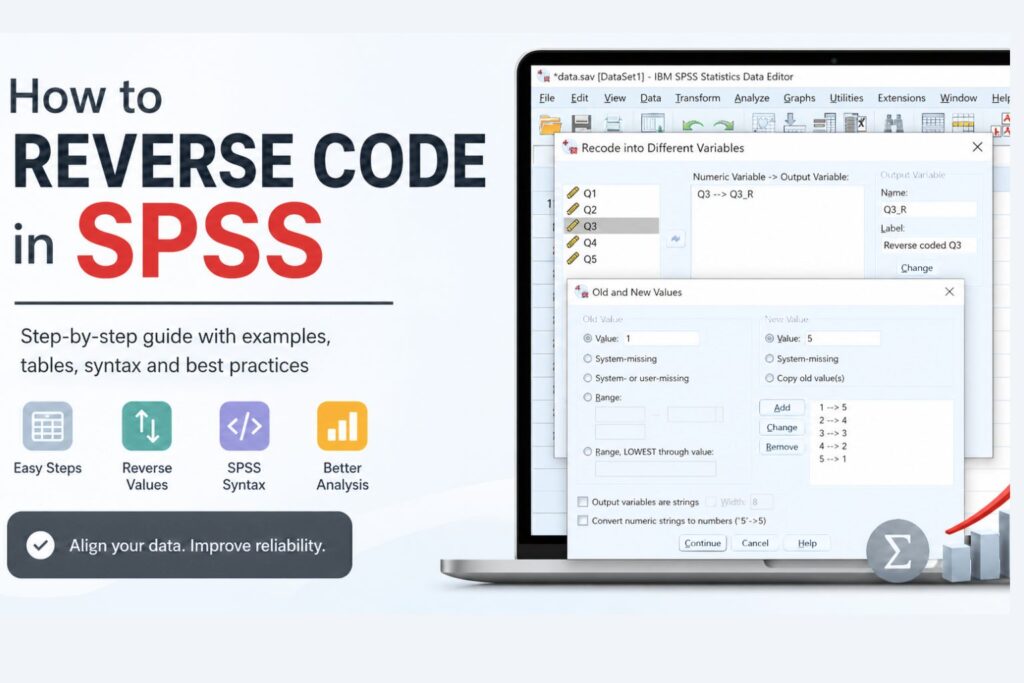
| 5 | Click Old and New Values | Defines the reverse coding pattern |
| 6 | Enter each old and new value pair | Reverses the scale direction |
| 7 | Click Continue and OK | Runs the recoding process |
| 8 | Check the new variable | Confirms correct coding |
Detailed SPSS Reverse Coding Procedure
Open your SPSS dataset and identify the item that needs to be reversed. Make sure the variable is coded numerically. Reverse coding works best when Likert responses have clear numeric values such as 1 to 5 or 1 to 7.
Go to Transform and choose Recode into Different Variables.
Move the variable you want to reverse into the input box. For example, move Q3 into the box.
In the output variable section, give the new variable a clear name. A good naming style is:
| Original Variable | Reversed Variable Name |
|---|---|
| Q3 | Q3_R |
| Stress4 | Stress4_R |
| Anxiety2 | Anxiety2_R |
| Satisfaction5 | Satisfaction5_R |
Then add a clear label, such as:
| Variable Name | Variable Label |
|---|---|
| Q3_R | Reverse coded Q3 |
| Stress4_R | Reverse coded stress item 4 |
| Anxiety2_R | Reverse coded anxiety item 2 |
Click Change so SPSS accepts the new variable name.
Next, click Old and New Values and enter the reverse coding pattern.
For a 5-point scale:
| Old Value | New Value |
|---|---|
| 1 | 5 |
| 2 | 4 |
| 3 | 3 |
| 4 | 2 |
| 5 | 1 |
Click Add after each pair. After entering all pairs, click Continue, then click OK.
SPSS will create a new variable at the end of the dataset.
How to Reverse Code a 7-Point Likert Scale in SPSS
For a 7-point Likert scale, the values are reversed as follows:
| Old Value | New Value |
|---|---|
| 1 | 7 |
| 2 | 6 |
| 3 | 5 |
| 4 | 4 |
| 5 | 3 |
| 6 | 2 |
| 7 | 1 |
The midpoint remains unchanged.
| Scale Type | Midpoint |
|---|---|
| 5-point scale | 3 |
| 7-point scale | 4 |
| 9-point scale | 5 |
If your dissertation uses different response options, always check the questionnaire scoring instructions before reversing items.
Reverse Coding Formula Method
You can also reverse code using a formula:
| Scale | Formula |
|---|---|
| 1 to 5 scale | New variable = 6 – old variable |
| 1 to 7 scale | New variable = 8 – old variable |
| 1 to 10 scale | New variable = 11 – old variable |
For example, if Q3 is measured from 1 to 5:
Q3_R = 6 – Q3
| Original Q3 | Formula | Reversed Q3_R |
|---|---|---|
| 1 | 6 – 1 | 5 |
| 2 | 6 – 2 | 4 |
| 3 | 6 – 3 | 3 |
| 4 | 6 – 4 | 2 |
| 5 | 6 – 5 | 1 |
This method is useful when you are comfortable using Transform > Compute Variable.
For more help with formulas, visit How to Compute Variables in SPSS.
SPSS Syntax for Reverse Coding
SPSS syntax can make reverse coding faster and more reliable, especially when several variables need to be reversed.
Syntax for a 5-Point Scale
RECODE Q3 (1=5) (2=4) (3=3) (4=2) (5=1) INTO Q3_R.
VARIABLE LABELS Q3_R 'Reverse coded Q3'.
EXECUTE.
Syntax for Several Items
RECODE Q3 Q7 Q11
(1=5) (2=4) (3=3) (4=2) (5=1)
INTO Q3_R Q7_R Q11_R.
EXECUTE.
Syntax Using Compute
COMPUTE Q3_R = 6 - Q3.
EXECUTE.
This works only when the scale is continuous and correctly coded from 1 to 5 with no special values mixed into the scoring range.
How to Check Whether Reverse Coding Worked
After reverse coding, always check the new variable before running analysis.
| Check | What to Look For |
|---|---|
| Frequencies | Values should match the reverse pattern |
| Descriptives | Minimum and maximum should stay within the scale |
| Cross-tabulation | Old and new values should move opposite ways |
| Reliability analysis | Cronbach’s alpha may improve after correct coding |
| Missing values | Missing values should not become valid scores |
A simple frequency table can confirm whether the reversed variable was created correctly.
Example Frequency Check
| Q3 Original | Q3_R Reversed |
|---|---|
| 1 | 5 |
| 2 | 4 |
| 3 | 3 |
| 4 | 2 |
| 5 | 1 |
If the values do not match this pattern, the reverse coding should be corrected before any analysis continues.
Reverse Coding Before Reliability Analysis
Reverse coding is especially important before running Cronbach’s alpha. If negatively worded items are not reversed, reliability may appear poor even when the scale is valid.
| Situation | Possible Effect |
|---|---|
| Reverse item not coded | Low Cronbach’s alpha |
| Item coded in wrong direction | Negative item-total correlation |
| Mixed item direction | Weak scale consistency |
| Correct reverse coding | More accurate reliability result |
If you are preparing dissertation scales, reverse coding should happen before creating composite scores or interpreting internal consistency.
For support with scale testing, visit Reliability Analysis Help.
Example: Reverse Coding Before Cronbach’s Alpha
Assume a researcher measures academic confidence using five items:
| Item | Direction | Reverse Code Needed? |
|---|---|---|
| Q1: I feel confident with academic writing. | Positive | No |
| Q2: I understand my research topic. | Positive | No |
| Q3: I often feel unable to complete research tasks. | Negative | Yes |
| Q4: I can interpret statistical results. | Positive | No |
| Q5: I feel prepared to complete my dissertation. | Positive | No |
Before running reliability analysis, Q3 should be reversed and included as Q3_R.
| Reliability Model | Items Included |
|---|---|
| Wrong model | Q1, Q2, Q3, Q4, Q5 |
| Correct model | Q1, Q2, Q3_R, Q4, Q5 |
This small correction can change the quality of the entire results chapter.
Reverse Coding Before Creating Composite Scores
Many dissertation projects create a mean score or total score after reverse coding. This is common in survey research.
| Construct | Items |
|---|---|
| Motivation | Q1, Q2, Q3_R, Q4, Q5 |
| Anxiety | A1, A2_R, A3, A4_R, A5 |
| Satisfaction | S1, S2, S3_R, S4, S5 |
A composite score should only include items that face the same direction. Otherwise, the mean or total score can be inaccurate.
Example:
COMPUTE Motivation_Mean = MEAN(Q1, Q2, Q3_R, Q4, Q5).
EXECUTE.
For full dissertation analysis support, visit Dissertation Data Analysis Help.
Common Mistakes When Reverse Coding in SPSS
| Mistake | Why It Is a Problem |
|---|---|
| Recoding into the same variable without backup | Original data may be lost |
| Reversing the wrong item | Scale meaning becomes distorted |
| Forgetting the midpoint | Neutral value may be wrongly changed |
| Ignoring missing values | Missing responses may become valid scores |
| Using wrong scale range | 1–7 items may be reversed as 1–5 items |
| Forgetting value labels | Output becomes confusing |
| Running reliability before reverse coding | Cronbach’s alpha may be inaccurate |
The safest approach is to create a new reversed variable, check the coding, update labels, and only then continue with analysis.
Reverse Coding Missing Values
Missing values need careful handling. If a missing value is coded as 99, 999, or -1, it should not be treated as part of the scale.
| Value | Meaning | Should It Be Reversed? |
|---|---|---|
| 1 | Strongly Disagree | Yes |
| 2 | Disagree | Yes |
| 3 | Neutral | Yes |
| 4 | Agree | Yes |
| 5 | Strongly Agree | Yes |
| 99 | Missing / No response | No |
Before reverse coding, define special missing values in SPSS under Variable View. This reduces the risk of turning missing responses into valid scale values.
Reverse Coding and Value Labels
After reverse coding, the value labels should match the new direction. This is often overlooked.
For example, after reversing a 5-point item:
| New Value | Correct Label |
|---|---|
| 1 | Strongly Disagree |
| 2 | Disagree |
| 3 | Neutral |
| 4 | Agree |
| 5 | Strongly Agree |
If value labels are copied incorrectly, the dataset may look confusing even when the numeric coding is correct. This matters when preparing dissertation tables, survey summaries, and SPSS output files for review.
Reverse Coding for Different Scale Types
Reverse coding depends on the scale range.
| Scale Range | Reverse Coding Pattern |
|---|---|
| 1 to 4 | 1=4, 2=3, 3=2, 4=1 |
| 1 to 5 | 1=5, 2=4, 3=3, 4=2, 5=1 |
| 1 to 6 | 1=6, 2=5, 3=4, 4=3, 5=2, 6=1 |
| 1 to 7 | 1=7, 2=6, 3=5, 4=4, 5=3, 6=2, 7=1 |
| 0 to 4 | 0=4, 1=3, 2=2, 3=1, 4=0 |
| 0 to 10 | 0=10, 1=9, 2=8, 3=7, 4=6, 5=5, 6=4, 7=3, 8=2, 9=1, 10=0 |
Always confirm whether your questionnaire starts at 0 or 1 before reverse coding.
Example Results After Reverse Coding
A dissertation results section may briefly mention reverse coding in the data preparation section.
| Data Preparation Step | Description |
|---|---|
| Reverse coding | Negatively worded items were reversed before scale construction |
| Reliability testing | Cronbach’s alpha was calculated after reverse coding |
| Composite scoring | Mean scores were created using correctly aligned items |
| Final analysis | Correlation and regression were performed using prepared scale scores |
Example Dissertation Wording
Before conducting reliability analysis, negatively worded questionnaire items were reverse coded so that higher scores consistently represented higher levels of the measured construct. After reverse coding, composite mean scores were calculated for each scale and used in the subsequent statistical analysis.
Reverse Coding and APA Reporting
Reverse coding is usually reported in the methods or data preparation section rather than the main results table.
| Section | How to Mention Reverse Coding |
|---|---|
| Methodology | Explain which items were reverse coded |
| Data preparation | State that negatively worded items were reversed |
| Reliability section | Mention that reliability was tested after reverse coding |
| Results chapter | Use the final correctly coded composite scores |
APA-Style Example
Negatively worded items were reverse coded prior to reliability analysis so that all items were scored in the same conceptual direction. Higher scores therefore reflected higher levels of the construct being measured.
Reverse Coding in SPSS for Dissertation Chapter 4
Chapter 4 depends heavily on clean and accurate data preparation. Reverse coding affects the quality of descriptive statistics, reliability analysis, correlation, regression, ANOVA, and other results.
| Analysis Type | Why Reverse Coding Matters |
|---|---|
| Descriptive statistics | Means reflect the correct direction |
| Reliability analysis | Internal consistency is tested accurately |
| Correlation | Relationships are not weakened by opposite coding |
| Regression | Predictors and outcomes are interpreted correctly |
| Factor analysis | Items load in the expected direction |
| Composite scores | Scale totals and means become meaningful |
For help with results presentation, visit Chapter 4 Dissertation Help.
When Reverse Coding Is Not Needed
Not every negative-looking item needs reverse coding. Reverse coding depends on how the construct is defined.
| Situation | Reverse Coding Needed? |
|---|---|
| Item measures the opposite construct intentionally | Not always |
| Item belongs to a separate subscale | Not always |
| Scale manual says not to reverse | No |
| Item is negatively worded but part of same construct | Usually yes |
| Item is already coded correctly in downloaded data | No |
If you are using a published scale, check the scoring guide before reversing items. Some instruments already provide scoring instructions.
Reverse Coding Checklist for SPSS
| Checklist Item | Completed? |
|---|---|
| Identify all negatively worded items | Yes / No |
| Confirm the scale range | Yes / No |
| Check missing value codes | Yes / No |
| Use Recode into Different Variables | Yes / No |
| Name reversed variables clearly | Yes / No |
| Apply correct old-new value pattern | Yes / No |
| Check frequency tables | Yes / No |
| Correct value labels | Yes / No |
| Run reliability after reverse coding | Yes / No |
| Use reversed items in composite scores | Yes / No |
A careful checklist prevents avoidable errors in dissertation analysis.
Why Students Often Need Help with Reverse Coding in SPSS
Reverse coding looks simple, but small mistakes can affect the whole dissertation. Many students only notice the issue after Cronbach’s alpha becomes too low, correlations look strange, or regression results do not make sense.
Common problems include:
| Problem | Example |
|---|---|
| Confusing reverse coding with general recoding | Grouping values instead of reversing direction |
| Losing original data | Using Recode into Same Variables |
| Wrong missing value handling | 99 becomes part of the reversed scale |
| Poor variable labels | Reversed items become hard to identify |
| Incorrect composite scores | Original and reversed items are mixed |
| Weak interpretation | Results chapter does not explain data preparation |
If your SPSS output looks confusing, you can request professional help through Request Quotes Now.
Professional SPSS Help for Reverse Coding and Data Preparation
SPSSDissertationhelp.com supports students and researchers with questionnaire coding, reverse coding, variable transformation, reliability analysis, descriptive statistics, hypothesis testing, regression, ANOVA, correlation, factor analysis, and dissertation results interpretation.
Support can include:
| Service Area | What It Covers |
|---|---|
| Data cleaning | Missing values, coding checks, outliers |
| Reverse coding | Negatively worded Likert items |
| Reliability analysis | Cronbach’s alpha and item-total statistics |
| Composite scores | Mean and total score creation |
| SPSS output review | Tables, assumptions, interpretation |
| Chapter 4 support | Results writing and presentation |
You can also explore SPSS Data Analysis Help if you need broader support with SPSS results.
FAQ: How to Reverse Code in SPSS
Reverse coding means changing the direction of a scale item so that high values become low values and low values become high values. It is commonly used for negatively worded questionnaire items.
You need to reverse code Likert scale items when some items are worded in the opposite direction from the construct being measured. This helps make scale scores consistent.
For dissertation work, Recode into Different Variables is safer because it keeps the original data unchanged and creates a new reversed variable.
Use this pattern: 1=5, 2=4, 3=3, 4=2, and 5=1.
Use this pattern: 1=7, 2=6, 3=5, 4=4, 5=3, 6=2, and 7=1.
Yes. For a 5-point scale, you can compute the reversed variable using New Variable = 6 – Old Variable. For a 7-point scale, use New Variable = 8 – Old Variable.
Yes. If negatively worded items are not reverse coded, Cronbach’s alpha may become low or misleading.
Yes. Reverse coding should be completed before reliability analysis, composite score creation, correlation, regression, or any major statistical test.
Check the questionnaire wording and scoring guide. Items written in the opposite direction from the construct often need reverse coding.
Yes. SPSSDissertationhelp.com can help with reverse coding, data cleaning, reliability analysis, SPSS output interpretation, and dissertation results writing. You can start through Request Quotes Now.
Final Thoughts
Reverse coding in SPSS is a small but important step in dissertation data analysis. When it is done correctly, your scale scores become more accurate, reliability analysis becomes more meaningful, and your final results become easier to interpret. When it is skipped or done incorrectly, even strong research data can produce weak or misleading findings.
For support with SPSS reverse coding, questionnaire preparation, reliability testing, and dissertation results, visit SPSS Dissertation Help or submit your details through Request Quotes Now.