
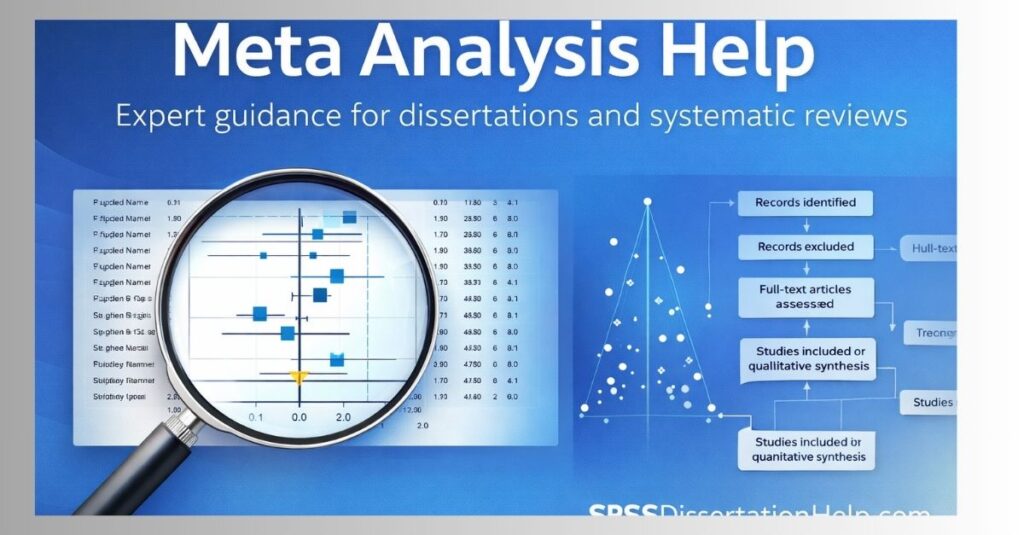
Professional Meta Analysis Assistance for Dissertations, Theses, and Peer Reviewed Journal Publications
Meta analysis represents one of the highest levels of quantitative evidence synthesis in academic research. It moves beyond simply describing patterns in the literature and instead applies statistical methodology to aggregate results across independent studies. When conducted properly, it provides a more precise and statistically defensible estimate of an effect than any single study alone. Because of this strength, meta analysis is widely regarded as a gold standard in evidence based research, particularly within healthcare, psychology, education, economics, and management sciences.
However, although the conceptual idea of “combining studies” sounds straightforward, the practical implementation is complex. Researchers must extract compatible effect sizes, calculate appropriate variances, apply weighting procedures, evaluate heterogeneity, test for publication bias, and justify model selection decisions. Each of these steps requires statistical literacy and methodological clarity. Errors at any stage can compromise the validity of findings and expose a dissertation to critical review.
At SPSSDissertationHelp.com, our structured approach to meta analysis help focuses on methodological rigor, transparency, and alignment with academic standards. We do not simply generate forest plots. We ensure your synthesis process is statistically sound, logically defensible, and clearly reported in a manner that meets examiner expectations and journal submission requirements.
If you are transitioning from a systematic review into quantitative synthesis, responding to supervisor feedback requesting stronger empirical integration, or preparing a manuscript for peer review, this guide explains both the process and the level of support we provide.
What Is Meta Analysis?
Meta analysis is a statistical framework used to combine numerical findings from multiple independent empirical studies investigating the same research question. Instead of narratively summarizing conclusions, it calculates a pooled effect size that represents the overall magnitude and direction of a relationship or treatment effect across studies.
For example, suppose twenty independent studies examine whether a leadership training program improves employee performance. Individual studies may show varying results due to sample size differences, contextual factors, or measurement variability. A meta analysis synthesizes those results quantitatively, producing an aggregated estimate that reflects the broader evidence base rather than isolated findings.
The strength of this method lies in its ability to:
- Increase statistical power
- Provide more stable effect size estimates
- Identify patterns across diverse populations
- Evaluate consistency across study designs
- Detect systematic bias
Meta analysis is commonly applied in:
- Clinical trials and medical interventions
- Psychological interventions and behavioral outcomes
- Educational program evaluation
- Organizational performance research
- Public policy evaluation
- Economic modeling studies
Unlike a traditional literature review, which summarizes themes and theoretical perspectives, a meta analysis introduces structured statistical integration. It produces measurable outputs such as pooled effect sizes, confidence intervals, heterogeneity statistics, and bias diagnostics.
For doctoral dissertations, this level of quantitative integration often strengthens methodological sophistication and demonstrates advanced analytical capability.
Why Students Seek Meta Analysis Help
Although meta analysis appears frequently in published journals, many postgraduate students have limited formal training in evidence synthesis methodology. Most statistics courses focus on regression, ANOVA, or structural modeling rather than effect size transformation across independent datasets. As a result, students often complete their systematic review stage successfully but feel uncertain when transitioning to quantitative pooling.
The most common challenges include:
- Converting diverse statistical formats into comparable effect sizes
- Extracting data from incomplete or poorly reported studies
- Adjusting for small sample bias
- Understanding weighting procedures
- Selecting between fixed and random effects models
- Interpreting heterogeneity statistics accurately
- Conducting moderator or subgroup analysis
- Reporting results according to PRISMA guidelines
Many dissertations are returned for revision because examiners detect unclear methodological reasoning. For instance, a student may choose a random effects model without explaining theoretical justification, or report I² statistics without interpreting their magnitude. These issues reduce analytical credibility.
Professional meta analysis help ensures that:
- Statistical decisions are justified
- Effect size calculations are accurate
- Model assumptions are transparent
- Results are interpreted correctly
- Reporting meets disciplinary standards
In academic research, clarity and defensibility are just as important as numerical accuracy.
Our Structured Approach to Meta Analysis Support
At SPSSDissertationHelp.com, our methodology follows a transparent, research driven process. We do not treat analysis as a mechanical exercise. Instead, we ensure every statistical decision aligns with your theoretical framework and research objectives.
Our structured workflow includes the following phases.
Phase 1: Research Design and Feasibility Assessment
Before conducting any synthesis, we evaluate whether your review qualifies for quantitative integration. Not all systematic reviews are suitable for meta analysis. We examine:
- Conceptual similarity between studies
- Measurement compatibility
- Study design consistency
- Availability of extractable statistical information
- Risk of methodological heterogeneity
For example, combining randomized controlled trials with purely observational designs may introduce substantial bias. We assess whether such variation can be statistically modeled or whether subgroup analysis is required.
If your broader dissertation requires integrated support across chapters, we ensure alignment with your existing Dissertation Statistics Consultant structure so that synthesis integrates seamlessly with your overall methodology chapter.
Phase 2: Effect Size Extraction and Standardization
Effect size is the backbone of meta analysis. Without proper standardization, combining studies becomes statistically invalid.
Depending on the reporting format in included studies, we calculate and convert:
- Cohen’s d for mean differences
- Hedges’ g for small sample correction
- Odds ratios and risk ratios for binary outcomes
- Correlation coefficients for association studies
- Fisher’s Z transformations for pooling correlations
- Standardized mean differences
Each effect size must include an associated variance or standard error to allow proper weighting. Many students underestimate the importance of accurate variance estimation, yet weighting errors significantly distort pooled results.
We carefully verify:
- Direction consistency
- Sample size accuracy
- Variance formulas
- Transformation accuracy
This stage requires precision, particularly when studies report incomplete data. In such cases, we may compute effect sizes from reported t values, F statistics, p values, or confidence intervals.
Phase 3: Model Selection and Theoretical Justification
One of the most debated decisions in meta analysis involves choosing between fixed and random effects models.
A fixed effects model assumes that all included studies estimate the same true effect. Any observed variation is attributed to sampling error.
A random effects model assumes that real differences exist between studies due to population characteristics, measurement tools, intervention designs, or contextual factors.
Choosing incorrectly can lead to misinterpretation.
We guide you through:
- Theoretical justification
- Statistical comparison
- Model sensitivity testing
- Reporting clarity
In most social science dissertations, random effects models are appropriate due to inherent contextual variability. However, justification must always be explicitly explained.
Phase 4: Heterogeneity Analysis
Heterogeneity measures the degree of variation across study results. It determines whether pooled estimates represent consistent findings or mask substantial variability.
We compute and interpret:
- Cochran’s Q statistic
- I² percentage
- Tau² variance
Interpretation requires nuance. For example:
- Low I² suggests consistency
- Moderate I² indicates potential subgroup differences
- High I² signals substantial variability requiring deeper investigation
Rather than merely reporting numbers, we explain what heterogeneity means for your research question and whether moderator analysis is statistically warranted.
Phase 5: Publication Bias and Robustness Testing
Publication bias occurs when studies with statistically significant results are more likely to be published than studies with null findings. Ignoring bias can inflate pooled effect sizes.
We assess bias using:
- Funnel plot visualization
- Egger’s regression test
- Trim and fill procedures
- Fail-safe N estimation
We also conduct sensitivity analysis to determine whether pooled results remain stable when individual studies are removed.
Examiners frequently expect bias diagnostics in doctoral dissertations. Omitting this step weakens methodological credibility.
Software Platforms Used in Meta Analysis
Meta analysis requires specialized statistical tools. Depending on project scope, we utilize:
- R (metafor and meta packages)
- Comprehensive Meta Analysis software
- RevMan for clinical research
- Stata for advanced modeling
- SPSS with validated macros
If your dissertation integrates additional regression modeling or hypothesis testing, we ensure continuity with SPSS Data Analysis Help so that all analytical sections align methodologically.
When projects involve mediation or moderation frameworks, we align synthesis findings with Mediation Analysis in SPSS workflows when appropriate.
Who We Support
Our meta analysis assistance supports:
- Master’s dissertations
- PhD theses
- Medical research projects
- Policy reviews
- Journal manuscript preparation
- Grant proposal evidence synthesis
For projects requiring broader methodological consultation, researchers may also explore our Hire Statistician for Dissertation service for comprehensive support.
Academic Reporting Standards
We structure outputs according to:
- PRISMA reporting guidelines
- APA 7th edition formatting
- Discipline specific journal standards
- Cochrane framework for health sciences
Deliverables may include:
- Forest plots
- Funnel plots
- Effect size summary tables
- Heterogeneity diagnostics tables
- Moderator analysis results
- Structured interpretation sections
Clear interpretation is critical. Many dissertations are returned for revision not because numbers are incorrect, but because interpretations lack clarity or fail to explain statistical implications in plain academic language.
Why SPSSDissertationHelp.com Is Different
Many websites offering statistical assistance operate as transactional platforms. They perform calculations but do not engage deeply with research design, theoretical alignment, or academic defensibility.
Our approach differs in several key ways:
- We prioritize methodological reasoning
- We ensure transparency in formulas and assumptions
- We structure interpretation for examiner review
- We align outputs with academic reporting conventions
- We provide structured consultation, not generic output
Your dissertation is not simply a statistical exercise. It is an intellectual contribution that must withstand scrutiny.
Advanced Statistical Procedures in Meta Analysis
A rigorous meta analysis requires more than pooling numbers from published studies. It demands a structured statistical framework that ensures comparability, validity, and interpretive clarity. Many dissertations struggle at this stage because effect size transformation, variance estimation, and weighting procedures require technical precision.
High-quality meta analysis integrates mathematical accuracy with conceptual reasoning. Every statistical decision must be defensible and transparent, especially in doctoral research where examiners carefully review methodological logic.
Effect Size Calculation and Standardization
Effect sizes form the foundation of quantitative synthesis. Because primary studies report results in different statistical formats, they must be converted into a common metric before pooling.
The most frequently used effect sizes include:
- Standardized mean differences
- Correlation coefficients
- Log odds ratios
- Risk ratios
- Mean differences
Each metric has its own assumptions, formulas, and variance calculations.
Standardized Mean Differences
When studies compare two groups, standardized mean differences allow aggregation across varying measurement scales. Cohen’s d is commonly used, though Hedges’ g provides correction for small sample bias.
The pooled standard deviation must be calculated correctly to avoid inflation or underestimation of the effect. Small sample corrections are especially important in social science dissertations where many primary studies involve limited sample sizes.
Variance estimation determines study weighting. Because weights are assigned based on inverse variance, even small miscalculations distort pooled estimates.
Correlation-Based Meta Analysis
When studies report correlations, direct pooling is statistically inappropriate due to distributional skew at extreme values. Fisher’s Z transformation ensures approximate normality prior to aggregation.
After pooling transformed values, results are converted back to correlation form for interpretation.
This step is critical in fields such as psychology, management, and education, where correlational research dominates. Misapplication of transformation formulas frequently leads to inaccurate pooled outcomes.
Researchers combining correlational synthesis with additional modeling may also align results with broader analytical services such as SPSS Data Analysis Help to ensure consistency across chapters.
Odds Ratios and Log Transformation
In medical and public health research, odds ratios are often the primary effect metric. Because odds ratios are asymmetrical around unity, logarithmic transformation is required before pooling.
Log odds ratios are combined using inverse variance weighting. Final results are then exponentiated for interpretability.
Clear interpretation is essential. A value above one indicates increased likelihood, while a value below one indicates reduced likelihood. Dissertation examiners frequently critique vague or overly simplified explanations of these metrics.
Weighting and Variance Structures
Meta analysis relies on inverse variance weighting to ensure that studies with greater precision contribute proportionally more to pooled estimates.
Weight is calculated as:
Weight = 1 / Variance
Under random effects models, between-study variance (Tau²) is incorporated into weighting formulas. This adjustment reduces dominance of extremely large studies and produces more conservative confidence intervals.
Understanding the logic of weighting strengthens methodological defense during dissertation evaluation.
Modeling Frameworks
Model selection is central to quantitative synthesis.
A fixed effects model assumes one true effect size underlying all included studies. Any observed variation is attributed to sampling error.
A random effects model assumes that true effect sizes differ across studies due to contextual or methodological variation.
In most applied research domains, heterogeneity is expected. Therefore, random effects models are frequently appropriate. However, selection must be justified theoretically and statistically.
Between-study variance can be estimated using methods such as:
- DerSimonian and Laird
- Restricted maximum likelihood
- Method of moments
Advanced dissertations sometimes compare estimators to assess robustness.
Heterogeneity Analysis
Heterogeneity statistics quantify the degree of variation across studies.
Cochran’s Q tests whether observed dispersion exceeds chance expectations. However, it is sensitive to study count.
The I² statistic expresses heterogeneity as a percentage of total variation attributable to real differences rather than sampling error.
Interpretation guidelines are commonly:
- Low heterogeneity
- Moderate heterogeneity
- Substantial heterogeneity
Tau² represents absolute variance between studies and informs random effects weighting.
Meaningful interpretation connects heterogeneity to research design differences, population characteristics, and measurement variability.
Subgroup Analysis and Meta Regression
When heterogeneity is substantial, moderator analysis becomes necessary.
Subgroup analysis compares pooled effects across categorical variables, such as:
- Geographic location
- Intervention duration
- Measurement tools
- Population demographics
Meta regression extends this logic by modeling continuous study-level predictors.
The meta regression equation resembles weighted regression:
Effect Size = β₀ + β₁X + ε
However, weights are based on inverse variance rather than simple sample size.
Care must be taken to avoid overfitting when the number of studies is small. Methodological prudence is essential for defensibility.
Projects requiring deeper modeling may also intersect with services such as Hire Statistician for Dissertation when integration across multiple statistical frameworks is required.
Sensitivity and Influence Diagnostics
Robustness checks are increasingly expected in doctoral research.
Common sensitivity procedures include:
- Leave-one-out analysis
- Influence diagnostics
- Cumulative meta analysis
- Excluding high-risk studies
These tests evaluate whether pooled results are driven disproportionately by individual studies.
Transparent reporting of sensitivity findings strengthens credibility and reduces vulnerability during defense.
Publication Bias Assessment
Publication bias threatens validity when studies with significant findings are more likely to appear in the literature.
Bias assessment methods include:
- Funnel plot visualization
- Egger’s regression test
- Trim and fill procedures
- Fail-safe N estimation
Interpreting funnel asymmetry requires caution. Visual patterns must be supplemented with statistical testing.
Dissertations that omit bias diagnostics often face methodological critique.
Handling Incomplete Reporting in Primary Studies
Meta analysis frequently requires reconstructing effect sizes from incomplete information.
Common scenarios include:
- Missing standard deviations
- Only p values reported
- Confidence intervals without raw data
- Incomplete group statistics
Effect sizes can often be derived from:
- t statistics
- F values
- Standard errors
- Confidence interval bounds
Every transformation must be documented transparently to preserve methodological integrity.
Integrating Meta Analysis Within a Dissertation
Meta analysis may function as:
- A standalone quantitative synthesis
- The empirical foundation for theoretical model development
- A precursor to primary data collection
In mixed-method dissertations, alignment with subsequent modeling is essential. Integration across statistical chapters ensures coherence and prevents methodological inconsistency.
Students conducting additional regression, mediation, or variance testing may also coordinate with services such as ANOVA Help or Mediation Analysis in SPSS when appropriate.
Academic Reporting and Interpretation
High-quality reporting includes:
- Clear explanation of effect size metrics
- Justified model selection
- Transparent heterogeneity interpretation
- Subgroup or moderator results
- Sensitivity outcomes
- Bias diagnostics
Interpretation must balance statistical rigor with conceptual clarity. Overstating pooled effects or ignoring limitations weakens scholarly credibility.
Academic writing should avoid exaggerated claims and instead focus on evidence-based conclusions.
PRISMA Framework and Structured Reporting in Meta Analysis
A statistically correct synthesis alone is not sufficient for a high-quality dissertation or journal manuscript. Meta analysis must also follow internationally recognized reporting standards to ensure transparency, replicability, and methodological credibility. One of the most widely accepted frameworks is PRISMA (Preferred Reporting Items for Systematic Reviews and Meta Analyses).
PRISMA provides structured guidance for documenting:
- Literature search strategy
- Inclusion and exclusion criteria
- Screening process
- Study selection flow
- Data extraction procedures
- Risk of bias evaluation
- Quantitative synthesis methods
Dissertations that fail to follow PRISMA often receive examiner feedback requesting methodological clarification. Structured compliance strengthens the academic defensibility of your research.
PRISMA Flow Diagram and Study Selection
The PRISMA flow diagram visually documents the journey from initial database search to final included studies. It typically includes:
- Number of records identified
- Number of duplicates removed
- Records screened
- Full-text articles assessed
- Studies excluded with reasons
- Final number included in synthesis
This level of transparency allows examiners and reviewers to evaluate the comprehensiveness of your search strategy. It also demonstrates methodological rigor.
When providing meta analysis help, we ensure the screening process is clearly documented and aligned with your research question.
Search Strategy Development
A rigorous meta analysis begins with a comprehensive search strategy. Weak search protocols can introduce selection bias and undermine the entire synthesis.
Key elements of a strong search strategy include:
- Clearly defined research question
- Use of Boolean operators
- Database selection justification
- Inclusion and exclusion criteria
- Date range rationale
- Language restrictions explanation
Commonly used databases include:
- PubMed
- Scopus
- Web of Science
- PsycINFO
- Google Scholar
Search strings must be reproducible. Examiners may request appendices showing full search queries.
Risk of Bias Assessment
Meta analysis does not simply combine studies. It evaluates study quality.
Risk of bias tools differ by research design. For example:
- Randomized controlled trials may use structured bias checklists
- Observational studies require confounding assessment
- Cross-sectional research may focus on measurement validity
Risk of bias domains typically include:
- Selection bias
- Performance bias
- Detection bias
- Attrition bias
- Reporting bias
Each included study should be rated systematically rather than subjectively.
Transparent bias assessment strengthens the credibility of pooled findings.
Quality Appraisal Tools
Several established appraisal frameworks are used across disciplines. Selection depends on research design.
Common tools include:
- Cochrane Risk of Bias Tool
- Newcastle Ottawa Scale
- JBI Critical Appraisal Tools
- CASP Checklists
Quality scoring should not be arbitrary. Researchers must explain how appraisal influenced synthesis decisions.
For example:
- Were low-quality studies excluded?
- Were sensitivity analyses performed excluding high-risk studies?
- Did quality scores inform moderator analysis?
Structured appraisal prevents accusations of selective inclusion.
Data Extraction Protocols
Data extraction must follow a predefined template to ensure consistency.
Typical extraction variables include:
- Author and publication year
- Sample size
- Population characteristics
- Intervention or exposure details
- Outcome measures
- Statistical values needed for effect size calculation
Double-checking extraction accuracy reduces calculation errors. Many dissertation errors stem from simple data transcription mistakes.
Professional support ensures that effect sizes are calculated from verified source data.
Advanced Interpretation of Forest Plots
Forest plots visually summarize individual study effects and the pooled estimate.
Key components include:
- Individual study effect sizes
- Confidence intervals
- Weight assigned to each study
- Overall pooled effect
- Heterogeneity statistics
Interpretation must address:
- Direction consistency
- Overlap of confidence intervals
- Influence of outliers
- Width of pooled confidence interval
Students often describe forest plots descriptively without explaining statistical implications. Strong interpretation connects graphical output to theoretical conclusions.
Funnel Plots and Bias Interpretation
Funnel plots visualize publication bias by plotting effect size against standard error.
Symmetry suggests low bias. Asymmetry may indicate:
- Publication bias
- Small-study effects
- True heterogeneity
However, visual interpretation alone is insufficient. Statistical tests such as Egger’s regression should accompany graphical inspection.
Clear explanation of bias diagnostics strengthens scholarly rigor.
Meta Regression Interpretation at Doctoral Level
Meta regression extends synthesis by examining study-level predictors.
Interpretation must include:
- Regression coefficients
- Standard errors
- Confidence intervals
- Significance levels
- Model fit statistics
Unlike traditional regression, meta regression uses weighted models accounting for within-study variance.
Examiners expect careful interpretation that avoids overstating causality. Meta regression identifies associations between study characteristics and effect sizes, not causal mechanisms.
Addressing High Heterogeneity
When heterogeneity is substantial, researchers must avoid simplistic pooling.
Strategies include:
- Subgroup analysis
- Meta regression
- Excluding extreme outliers
- Exploring methodological differences
Failure to address high heterogeneity is a common weakness in dissertations.
We ensure that heterogeneity findings are discussed critically and tied back to research design variation.
Writing the Methodology Chapter for Meta Analysis
The methodology chapter should include:
- Research question formulation
- Search strategy details
- Inclusion and exclusion criteria
- Data extraction process
- Effect size metrics
- Model selection rationale
- Heterogeneity testing procedures
- Bias diagnostics
Clarity and logical flow are essential. Technical explanations should be precise yet accessible.
Writing the Results Chapter
Results should present:
- Number of included studies
- Pooled effect size with confidence interval
- Heterogeneity statistics
- Subgroup results
- Sensitivity analysis outcomes
- Bias test results
Tables and figures must be labeled clearly and interpreted thoroughly.
Avoid presenting numerical output without explanation. Interpretation must guide the reader through statistical meaning.
Writing the Discussion Section
The discussion should:
- Interpret magnitude of pooled effects
- Compare findings with prior literature
- Explain heterogeneity implications
- Acknowledge limitations
- Avoid overgeneralization
Limitations often include:
- Small number of studies
- Variation in measurement tools
- Risk of bias
- Publication bias
- Limited geographic diversity
Balanced discussion enhances academic credibility.
Ethical Considerations in Meta Analysis
Ethical research synthesis includes:
- Transparent reporting
- Accurate representation of primary findings
- Avoiding selective inclusion
- Citing all included studies properly
Meta analysis does not require ethical approval for human subjects, but ethical integrity remains essential.
Integration with Broader Dissertation Services
Students conducting additional analyses may integrate findings with:
Coordinated analytical strategy prevents fragmentation across chapters.
Why Structured Guidance Matters
Meta analysis is often perceived as an advanced research method reserved for experienced scholars. However, with structured statistical guidance and transparent reporting, postgraduate students can conduct high-level synthesis that meets international standards.
Professional support ensures:
- Accurate effect size transformation
- Proper model selection
- Transparent heterogeneity interpretation
- Robust bias assessment
- Examiner-ready reporting
When You Should Seek Professional Meta Analysis Support
Meta analysis is one of the most technically demanding quantitative research methods used in postgraduate and doctoral studies. While many researchers begin with confidence during the systematic review stage, the statistical synthesis phase often introduces uncertainty.
You may benefit from structured meta analysis help if:
- You have completed study screening but are unsure how to calculate effect sizes
- Your supervisor has requested heterogeneity analysis or moderator testing
- You are unclear whether to use fixed or random effects modeling
- Your I² values are high and you do not know how to interpret them
- You need publication-ready forest and funnel plots
- Your dissertation has been returned for statistical clarification
- You are preparing a manuscript for peer review
Seeking expert guidance is not about outsourcing thinking. It is about ensuring statistical decisions are accurate, transparent, and defensible.
Common Academic Concerns About Meta Analysis
Students frequently raise important questions before proceeding with quantitative synthesis.
“What if my included studies are very different?”
Substantial variation does not automatically invalidate synthesis. Instead, heterogeneity must be measured and interpreted appropriately. Random effects modeling, subgroup analysis, or meta regression may address variability.
“What if I only have a small number of studies?”
While larger numbers increase statistical power, meta analysis can still be conducted with smaller study sets. However, interpretation must be cautious, and moderator analysis may be limited.
“What if some studies do not report full statistics?”
Effect sizes can often be reconstructed from reported test statistics, p values, or confidence intervals. Transparent documentation is essential.
“Will examiners question my model choice?”
They may, which is why model selection must be justified theoretically and statistically. Clear explanation strengthens your defense.
Academic-Level Deliverables You Can Expect
When you request structured support from SPSSDissertationHelp.com, your deliverables may include:
- Fully calculated effect sizes with formulas documented
- Variance and weighting transparency
- Justified model selection
- Forest plot interpretation
- Funnel plot analysis
- Heterogeneity explanation
- Moderator or subgroup testing
- Sensitivity analysis documentation
- Bias diagnostics interpretation
- Dissertation-ready methodology and results sections
All outputs are aligned with APA formatting and PRISMA structure.
How Meta Analysis Strengthens Your Dissertation
A well-executed meta analysis enhances:
- Statistical sophistication
- Methodological credibility
- Theoretical contribution
- Publication potential
- Defense confidence
Rather than presenting isolated study summaries, you provide quantitative evidence synthesis that reflects broader patterns across the literature.
Request a Quote for Meta Analysis Help
If you are ready to proceed, requesting a quote is straightforward.
Please provide:
- Your research topic
- Number of studies included
- Type of reported statistical outcomes
- Academic level (Master’s, PhD, journal submission)
- Deadline
You will receive:
- A feasibility assessment
- Recommended analytical plan
- Timeline
- Transparent pricing structure
Every consultation is confidential and tailored to your academic needs.
Frequently Asked Questions
What is the difference between a systematic review and meta analysis?
A systematic review identifies and evaluates relevant studies using structured screening criteria. A meta analysis statistically combines quantitative findings from those studies to calculate pooled effect sizes.
How many studies are required for meta analysis?
There is no strict minimum. However, more studies generally improve statistical stability. Smaller numbers require cautious interpretation.
Can SPSS conduct meta analysis?
SPSS can support certain calculations with macros, but advanced synthesis often requires specialized packages such as R or dedicated meta analysis software.
Is random effects always better than fixed effects?
Not necessarily. The choice depends on theoretical assumptions and heterogeneity levels. Random effects are common in social sciences due to study variability.
What is I² and why is it important?
I² quantifies the percentage of variation across studies attributable to heterogeneity rather than sampling error. It guides interpretation and model decisions.
What if publication bias is detected?
Bias does not automatically invalidate findings. Instead, it must be reported transparently, and corrective methods such as trim and fill may be applied.
Do I need ethical approval for meta analysis?
Typically, no. Because meta analysis uses already published data, new human subjects are not involved. However, ethical reporting standards still apply.
Can I publish my meta analysis after completing my dissertation?
Yes. Many dissertations are converted into journal manuscripts. Proper statistical structure increases publication readiness.
Final Considerations Before Beginning
Before initiating quantitative synthesis, ensure that:
- Your research question is clearly defined
- Inclusion criteria are finalized
- Screening is complete
- Data extraction sheets are organized
- You understand reporting expectations
If uncertainty remains at any stage, structured consultation reduces risk of methodological revision.
Meta analysis requires precision, but with the right guidance, it becomes a powerful tool for academic advancement.
Contact SPSSDissertationHelp.com Today
Meta analysis is not merely a statistical technique. It is a comprehensive research methodology that demands structured planning, accurate computation, and scholarly interpretation.
If you require reliable, academically aligned meta analysis help, submit your consultation request today and receive a structured analytical roadmap tailored to your dissertation or publication goals.