
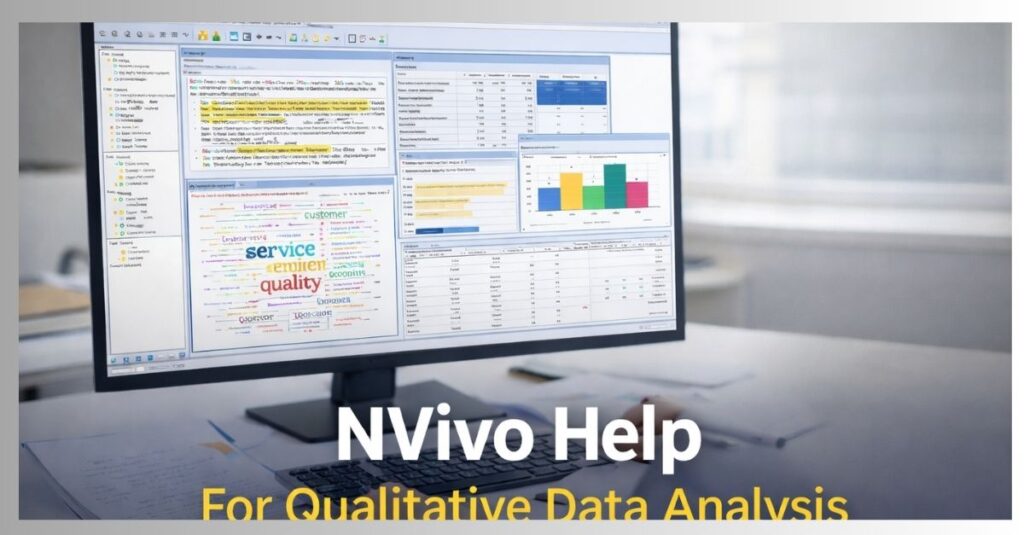
NVivo Help: Professional NVivo Data Analysis Support for Researchers
Introduction to NVivo Help
Qualitative research is widely used in academic studies across disciplines such as sociology, education, healthcare, psychology, and business management. Researchers often collect qualitative data through interviews, focus groups, open-ended survey questions, observations, and policy documents. These sources provide valuable insights into human experiences, attitudes, and behaviors. However, analyzing large volumes of qualitative data can be difficult without appropriate analytical tools.
NVivo is one of the most widely used qualitative data analysis software programs designed to help researchers organize and interpret qualitative information. The software allows researchers to store multiple data sources in a single project, apply coding structures, identify patterns within data, and generate visualizations that support research findings. NVivo also supports multimedia data analysis, allowing researchers to examine audio, video, and image content alongside text-based materials.
Despite its powerful capabilities, many students and researchers struggle to use NVivo effectively. The software requires both technical familiarity and an understanding of qualitative research methods. Researchers who are new to qualitative analysis often find it challenging to organize datasets, develop coding frameworks, and interpret analytical results.
Professional NVivo Help services support researchers who need guidance during qualitative data analysis. These services assist with NVivo project setup, data coding, thematic analysis, and interpretation of qualitative findings. At SPSSDissertationHelp.com, our experts provide NVivo support for graduate students, researchers, and professionals working on academic research projects.
Understanding how NVivo works allows researchers to analyze qualitative data more efficiently and produce well-structured research findings.
What is NVivo Software
NVivo is specialized software designed for qualitative data analysis. Unlike statistical programs such as SPSS or R, which analyze numerical data, NVivo focuses on analyzing non-numerical information such as text, audio recordings, images, and videos.
Researchers use NVivo to organize and examine qualitative datasets collected during research studies. The software provides tools for coding data, identifying patterns, and exploring relationships between concepts. NVivo helps researchers manage complex qualitative datasets by allowing them to categorize information systematically.
Common types of data analyzed in NVivo include interview transcripts, focus group discussions, policy documents, field notes, social media content, and multimedia recordings. The software enables researchers to store all research materials within a single project environment, making it easier to manage large datasets.
One of the most important features of NVivo is coding. Coding involves assigning labels to sections of qualitative data that represent themes or concepts relevant to the research question. These codes help researchers identify patterns and relationships across different data sources.
NVivo also provides visualization tools that allow researchers to generate charts, diagrams, and conceptual maps. These visual outputs make it easier to interpret qualitative findings and present them clearly in research reports.
Researchers who are unfamiliar with the software often seek professional NVivo Help to learn how to use the platform effectively.
Why Researchers Need NVivo Help
Although NVivo is designed to assist qualitative analysis, many researchers find the software challenging when they first begin using it. Qualitative research requires careful methodological planning, and mistakes during coding or data organization can lead to inaccurate interpretations.
One common challenge involves learning the NVivo interface. The software contains many tools for coding, data organization, and analysis, and new users often struggle to navigate these features.
Another challenge is managing large qualitative datasets. Research projects that involve dozens of interviews or documents can quickly become difficult to organize without proper project structure. NVivo experts help researchers organize data sources efficiently so that analysis can proceed smoothly.
Developing coding frameworks is another area where researchers frequently need assistance. Codes must be designed carefully to reflect the research objectives and theoretical framework of the study. Poorly designed coding schemes can produce weak or inconsistent findings.
Researchers also require help interpreting coded data and generating meaningful conclusions from qualitative analysis. Professional NVivo support helps researchers translate coded results into clear research insights.
Students conducting qualitative dissertations often combine NVivo analysis with quantitative analysis tools such as SPSS. In such cases, researchers may seek support from both NVivo Help and SPSS Data Analysis Help to complete their research projects successfully.
Types of NVivo Help Services
Professional NVivo support services assist researchers at different stages of the qualitative research process. These services can be tailored depending on the size of the dataset and the research objectives.
NVivo project setup
The first stage of NVivo analysis involves creating a project file and importing research materials. NVivo Help services assist researchers with organizing documents, transcripts, and multimedia data sources within the software.
Qualitative data coding
Coding is one of the most important steps in qualitative analysis. NVivo experts help researchers develop coding frameworks that categorize sections of qualitative data according to themes and concepts.
Thematic analysis
Thematic analysis involves identifying patterns across coded data and interpreting relationships between themes. NVivo provides tools that help researchers explore these relationships and develop meaningful conclusions.
Qualitative visualization
NVivo can generate charts, diagrams, and conceptual models that illustrate research findings. These visualizations support the interpretation and presentation of qualitative data.
Dissertation NVivo support
Graduate students frequently require assistance performing NVivo analysis for thesis or dissertation projects. Professional NVivo Help ensures that qualitative methods are applied correctly and meet academic research standards.
Example NVivo Coding Framework
During qualitative research, coding frameworks are used to categorize sections of data according to themes. The following table demonstrates an example coding structure used in a customer experience study.
| Code | Theme | Description |
|---|---|---|
| C1 | Customer Satisfaction | Positive customer experiences |
| C2 | Service Quality | Comments about service delivery |
| C3 | Product Reliability | Feedback about product performance |
| C4 | Pricing Concerns | Opinions about product pricing |
Coding frameworks help researchers systematically organize qualitative information and identify patterns within the dataset.
Steps for Conducting Qualitative Analysis in NVivo
Researchers typically follow several steps when analyzing qualitative data using NVivo.
Step one involves creating a new NVivo project and defining the research objectives.
Step two involves importing research materials into the project. These materials may include interview transcripts, documents, and multimedia files.
Step three focuses on developing a coding structure that reflects the research questions and theoretical framework.
In step four, researchers code the data by assigning sections of text or multimedia content to thematic categories.
The fifth stage analyzes coded data to identify patterns, relationships, and recurring themes.
Next, visualizations are generated to summarize the findings and highlight important patterns.
Finally, the results are interpreted and integrated into the research report.
Researchers performing qualitative research often consult NVivo Help services to ensure that these steps are completed correctly.
Example NVivo Results Table
NVivo can generate summary tables that show how frequently themes appear across different data sources.
| Theme | Number of References | Number of Sources |
|---|---|---|
| Customer Satisfaction | 42 | 11 |
| Service Quality | 35 | 9 |
| Pricing Concerns | 27 | 8 |
| Product Reliability | 31 | 10 |
These tables help researchers identify which themes appear most frequently in the dataset and provide evidence supporting qualitative findings.
Original NVivo Screenshot Suggestions
To avoid copyright issues, it is recommended to include screenshots from your own NVivo software installation.
Useful screenshots may include the NVivo project dashboard, coding interface, coding tree structure, word frequency visualization, and thematic analysis charts.
These images provide visual examples of NVivo analysis and help readers understand how the software works.
Understanding Coding in NVivo
Coding is the central process in qualitative data analysis using NVivo. Coding involves labeling sections of qualitative data according to themes or concepts that relate to the research questions. This process allows researchers to organize large volumes of information and identify patterns that may not be visible during initial data review.
In NVivo, coding is performed by assigning segments of text, images, or multimedia files to nodes. Nodes represent thematic categories created by the researcher. As coding progresses, each node collects references from different data sources that relate to the same concept.
Coding can be performed manually by carefully reviewing each document and assigning relevant text segments to thematic categories. NVivo also provides tools that assist with automated coding based on keywords or structured survey responses. While automated coding can save time, manual coding remains important because it allows researchers to interpret the context and meaning of qualitative responses.
Researchers conducting dissertation studies often develop coding structures that align with theoretical frameworks or research objectives. A well-designed coding system helps ensure that qualitative analysis remains consistent and methodologically sound.
Graduate students who are unfamiliar with coding procedures sometimes seek professional NVivo Help to ensure that coding frameworks are designed properly and applied consistently across their datasets.
Creating Nodes in NVivo
Nodes are the primary structures used for coding qualitative data in NVivo. Each node represents a theme, category, or concept identified during the research process. When researchers code data, they link sections of text or media files to the relevant node.
Creating nodes typically begins with reviewing research questions and identifying key themes that may appear in the data. These themes form the initial coding framework. As researchers analyze the dataset, additional nodes may be created to represent emerging concepts.
Nodes can be organized hierarchically using parent and child relationships. Parent nodes represent broader categories, while child nodes represent more specific subthemes within those categories.
Example node hierarchy structure.
| Parent Node | Child Node |
|---|---|
| Customer Experience | Satisfaction |
| Customer Experience | Service Issues |
| Product Feedback | Product Quality |
| Product Feedback | Pricing Concerns |
This hierarchical structure allows researchers to organize themes logically and explore relationships between concepts.
Researchers working with complex coding frameworks often consult NVivo Help services to ensure that node structures align with qualitative research methodology.
Coding Qualitative Data in NVivo
After creating nodes, researchers begin coding qualitative data. Coding involves reviewing each data source and assigning relevant sections of content to appropriate nodes.
The coding process typically begins with reading interview transcripts or documents carefully. When a researcher identifies a statement related to a specific theme, that section of text is highlighted and assigned to a node.
NVivo allows researchers to code the same section of data to multiple nodes. This feature is useful when a single response relates to more than one theme.
Coding can be applied to various types of qualitative data including text documents, PDF files, images, audio recordings, and video clips. NVivo automatically records coding references, allowing researchers to track how frequently themes appear across different data sources.
Coding consistency is important during qualitative analysis. Researchers must apply the same coding logic throughout the dataset to ensure reliable results. Coding guidelines and codebooks are often developed to maintain consistency.
Researchers performing large qualitative studies sometimes seek assistance from NVivo Help to manage coding processes and ensure that data are categorized accurately.
Example Coding Summary Table
After coding qualitative data, NVivo can generate summary tables that show how frequently themes appear within the dataset.
Example coding summary table.
| Node | References | Sources |
|---|---|---|
| Customer Satisfaction | 48 | 12 |
| Service Quality | 36 | 10 |
| Pricing Concerns | 29 | 9 |
| Product Reliability | 33 | 11 |
These summaries help researchers identify which themes are most prominent within the dataset. High reference counts indicate themes that appear frequently across different interviews or documents.
Coding summaries also help researchers compare themes across multiple participants or groups within the study.
Students conducting qualitative dissertations often consult NVivo Help services when interpreting coding summaries and linking them to research findings.
Using Word Frequency Analysis in NVivo
Word frequency analysis is another useful tool available in NVivo. This feature identifies the most commonly used words within qualitative datasets and helps researchers explore recurring patterns in textual data.
Word frequency analysis is particularly useful during the early stages of qualitative research. It allows researchers to gain an overview of the dataset before performing detailed coding.
NVivo can generate word frequency charts and word clouds that visually represent commonly occurring terms. These visualizations help researchers identify keywords and potential themes that may require further analysis.
Example word frequency results.
| Word | Count |
|---|---|
| Service | 52 |
| Customer | 49 |
| Quality | 41 |
| Price | 37 |
| Experience | 35 |
Although word frequency analysis provides useful insights, researchers should interpret results carefully. High word counts do not necessarily indicate meaningful themes without contextual analysis.
Researchers performing qualitative content analysis sometimes seek professional NVivo Help when interpreting word frequency results.
Using NVivo Queries for Advanced Analysis
NVivo provides several query tools that allow researchers to explore relationships within qualitative datasets. Queries help researchers investigate patterns that may not be obvious through simple coding analysis.
One commonly used query is the text search query. This tool allows researchers to search for specific words or phrases across all data sources. It can be used to locate relevant passages that may require coding.
Another important query type is the coding query. Coding queries allow researchers to examine relationships between different themes. For example, a researcher might investigate how frequently “customer satisfaction” appears alongside “service quality.”
NVivo also provides matrix coding queries. These queries allow researchers to compare themes across demographic groups or participant categories.
Example matrix coding table.
| Theme | Male Participants | Female Participants |
|---|---|---|
| Customer Satisfaction | 20 | 28 |
| Service Quality | 18 | 22 |
| Pricing Concerns | 15 | 14 |
Matrix coding queries are particularly useful when researchers want to compare responses across different groups.
Graduate researchers sometimes seek assistance from NVivo Help when performing advanced query analysis in NVivo.
NVivo Visualization Tools
Visualization tools in NVivo help researchers present qualitative findings in a clear and engaging format. Visual outputs allow readers to understand patterns within qualitative datasets more easily.
NVivo offers several visualization features including word clouds, cluster analysis diagrams, coding hierarchy charts, and conceptual maps. These visualizations illustrate relationships between themes and help researchers communicate findings effectively.
Concept maps are particularly useful when researchers want to demonstrate relationships between multiple concepts within the dataset. Cluster analysis diagrams group similar data sources or nodes based on coding patterns.
Visualization outputs can be included in academic reports to support qualitative findings and illustrate analytical conclusions.
Researchers preparing qualitative research reports often consult NVivo Help services to create visual outputs that effectively communicate their findings.
Using NVivo for Dissertation Research
NVivo is widely used in graduate research because it provides powerful tools for analyzing qualitative datasets collected during thesis and dissertation studies. Many graduate students collect qualitative data through interviews, focus groups, open-ended surveys, and document analysis. Managing these materials manually can become extremely time-consuming, especially when datasets include dozens of transcripts and research documents.
NVivo helps researchers organize these materials within a single project environment. Interview transcripts, research notes, and supporting documents can be imported into the software and coded according to thematic categories. This structure allows researchers to track patterns and relationships within their qualitative datasets more efficiently.
During dissertation research, NVivo is commonly used for thematic analysis, grounded theory research, content analysis, and narrative analysis. Each of these methods requires systematic coding and interpretation of qualitative data.
Graduate researchers often encounter difficulties during the coding and interpretation stages of qualitative analysis. Developing appropriate coding frameworks, managing large datasets, and interpreting patterns across multiple interviews require methodological experience. For this reason, many students seek professional NVivo Help when performing qualitative data analysis for their dissertations.
Expert assistance ensures that coding structures align with research objectives and that qualitative findings are interpreted correctly within the context of the research study.
Common Challenges Researchers Face When Using NVivo
Although NVivo is designed to simplify qualitative research, many researchers encounter challenges when learning how to use the software effectively. One common issue involves understanding the NVivo interface. The software contains numerous tools for coding, querying data, and generating visualizations, and new users may find it difficult to navigate these features.
Another challenge involves organizing qualitative datasets before analysis begins. When researchers import documents into NVivo without a clear project structure, it can become difficult to manage coding and analysis later in the research process.
Developing a consistent coding framework is also challenging. Codes must reflect the theoretical framework of the study and remain consistent across all data sources. Inconsistent coding can produce misleading analytical results.
Researchers also struggle with interpreting NVivo outputs. Coding summaries, query results, and visualization diagrams must be interpreted carefully in order to draw meaningful conclusions from the data.
Because qualitative analysis requires both methodological understanding and technical skills, many researchers seek professional NVivo Help services to guide them through the analysis process.
Example Thematic Analysis Results
After coding qualitative data in NVivo, researchers often summarize the findings using thematic analysis tables. These tables show how frequently themes appear across the dataset and help identify patterns within the data.
Example thematic summary.
| Theme | Number of References | Number of Sources |
|---|---|---|
| Customer Satisfaction | 44 | 12 |
| Service Quality | 38 | 10 |
| Product Reliability | 31 | 9 |
| Pricing Concerns | 27 | 8 |
The table above illustrates how qualitative themes appear across multiple sources such as interview transcripts or documents. Themes with higher reference counts indicate issues that were frequently mentioned by participants.
Researchers often combine these summary tables with direct quotations from participants to illustrate how themes emerge within the dataset.
Students conducting qualitative dissertations frequently seek assistance from NVivo Help services when summarizing thematic results and preparing findings chapters.
NVivo Visualization Outputs
NVivo provides several visualization tools that help researchers illustrate qualitative findings. Visual outputs make it easier to present complex patterns in qualitative data and improve the clarity of research reports.
Common NVivo visualizations include word frequency clouds, coding hierarchy charts, cluster analysis diagrams, and conceptual maps. Word clouds display frequently used terms in the dataset, allowing researchers to identify recurring topics in qualitative responses.
Coding hierarchy charts illustrate how nodes are organized within the coding framework. These charts help researchers understand relationships between themes and subthemes.
Cluster analysis diagrams group similar sources or nodes based on coding similarities. These diagrams help researchers explore relationships between data sources and themes.
Concept maps visually represent relationships between different concepts identified during qualitative analysis.
These visualization tools help researchers communicate qualitative findings more effectively in research reports, presentations, and dissertations.
Researchers often seek professional NVivo Help when generating visualizations to ensure that outputs accurately represent their analytical results.
Benefits of Professional NVivo Help
Professional NVivo support services provide researchers with expert guidance throughout the qualitative analysis process. These services help researchers overcome technical challenges and ensure that qualitative methods are applied correctly.
One major benefit is improved research efficiency. NVivo experts can assist researchers in organizing datasets, creating coding structures, and performing analysis more quickly than researchers who are unfamiliar with the software.
Professional assistance also improves methodological accuracy. Experts ensure that coding frameworks align with qualitative research methods and that analysis procedures follow accepted research standards.
Another advantage involves interpretation of results. NVivo outputs must be translated into meaningful research insights. Expert guidance helps researchers interpret patterns within the data and present findings clearly.
Professional NVivo Help is particularly valuable for graduate students conducting dissertation research because it ensures that qualitative analysis meets academic expectations.
Example NVivo Project Summary Table
Researchers often summarize NVivo project information in research reports. The following table illustrates how qualitative datasets may be organized in an NVivo project.
| Data Source | Number of Files | Description |
|---|---|---|
| Interview Transcripts | 15 | Participant interviews |
| Focus Group Discussions | 5 | Group discussions |
| Policy Documents | 7 | Government reports |
| Survey Responses | 50 | Open-ended responses |
This type of summary table helps readers understand the structure of the qualitative dataset used in the research project.
Researchers performing large qualitative studies often consult NVivo Help services to manage complex datasets and maintain organized NVivo projects.
Frequently Asked Questions About NVivo Help
What is NVivo used for
NVivo is qualitative data analysis software used to organize, code, and analyze non-numerical research data such as interviews, documents, images, and multimedia files.
Can NVivo analyze interview transcripts
Yes. NVivo is commonly used to analyze interview transcripts by coding sections of text according to thematic categories.
Is NVivo used for dissertation research
Yes. Many graduate students use NVivo to perform qualitative analysis for thesis and dissertation research projects.
What types of data can NVivo analyze
NVivo can analyze text documents, PDFs, audio recordings, video files, images, and social media data.
Why do researchers seek NVivo Help
Researchers seek NVivo Help to learn how to code qualitative data, organize datasets, perform thematic analysis, and interpret results.
Can NVivo be used alongside statistical software
Yes. Many research studies combine qualitative analysis using NVivo with quantitative analysis using statistical software such as SPSS.
Researchers who require assistance with qualitative research methods often seek professional NVivo Help to support their projects.
Request NVivo Help for Your Research Project
Performing qualitative data analysis can be challenging, particularly when working with large datasets and complex research designs. Professional NVivo Help services provide researchers with expert guidance throughout the qualitative analysis process.
At SPSSDissertationHelp.com, our NVivo specialists assist researchers with project setup, coding frameworks, thematic analysis, visualization of findings, and interpretation of qualitative results. Our services support graduate students, researchers, and professionals working on academic studies and research projects.
Our NVivo Help services include:
• NVivo project setup and dataset organization
• Coding and thematic analysis of qualitative data
• NVivo visualization and query analysis
• Interpretation of qualitative findings
• Dissertation results chapter support
If you need expert support with NVivo qualitative data analysis, our team is ready to help.
Request a Quote today at SPSSDissertationHelp.com and receive professional NVivo Help for your research project.