
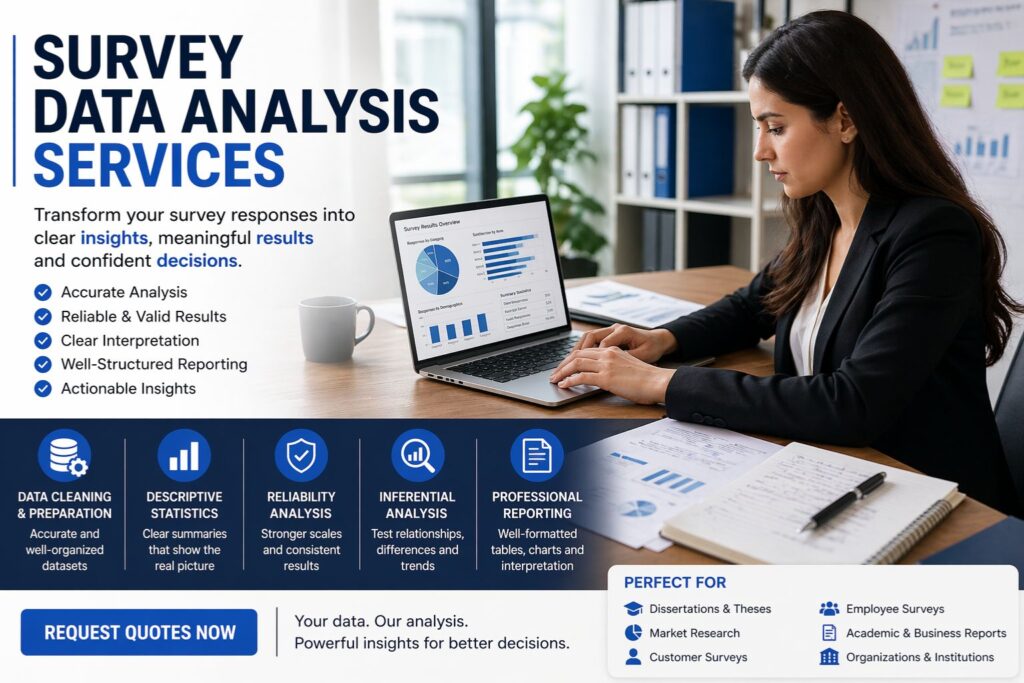
Survey Data Analysis Services
Survey data analysis services help turn completed questionnaires into findings that are clear, credible, and useful. Many students, researchers, and organizations collect good survey responses but struggle when it is time to make sense of the data. The challenge is rarely the questionnaire alone. The challenge is how the responses are cleaned, organized, tested, interpreted, and presented. A strong survey analysis brings all of those parts together so the final results do not feel scattered or uncertain. Instead, they read as a clear body of evidence that supports the purpose of the study or report.
Survey projects are common across business, nursing, education, psychology, public health, management, and the social sciences. They are also widely used in customer research, employee feedback, service evaluation, training assessment, and institutional reporting. Even so, survey datasets are often more demanding than they first appear. A file may include demographic items, grouped statements, rating scales, coded responses, missing values, and sections that measure different concepts. Good analysis brings order to that complexity and helps the final results feel polished, dependable, and ready to use.
If you want your survey findings handled carefully from the dataset stage to the final write-up, you can Request Quotes Now.
Survey Results Should Feel Clear, Not Confusing
A good survey analysis does more than produce tables. It helps the results make sense. It shows what respondents reported, where the strongest patterns appear, how groups differ, and which findings deserve the most attention. When the work is done well, the data stops looking like a collection of responses and starts reading like evidence. That difference matters in both academic and professional settings because the value of survey data depends on how clearly the findings can be understood and defended.
This is especially important when the survey supports a dissertation, thesis, institutional report, or business decision. In those settings, weak reporting can make even useful data feel uncertain. Strong reporting has the opposite effect. It gives structure to the findings, helps the reader follow the results easily, and makes the conclusions feel grounded. That is why this service is built around clarity as much as technical accuracy. The goal is not just to analyze responses. It is to present them in a way that gives the final work more strength.
Where survey analysis forms one part of a wider quantitative project, SPSS Dissertation Help often becomes a natural next step.
What Survey Data Analysis Services Include
Survey data analysis begins long before the final statistical test. The first stage often involves reviewing the questionnaire and the dataset together so the structure of the responses is fully understood. Some files arrive clean and ready for analysis, while others need substantial preparation. Response categories may need to be standardized. Variables may need clearer labels. Missing values may need attention. Reverse-coded items may need to be corrected. Grouped items may need to be checked before they can be reported as part of one scale. These details shape the quality of the entire outcome.
Once the dataset is properly prepared, the work may include descriptive analysis, scale review, reliability testing, group comparisons, relationship testing, regression-based interpretation, or more advanced procedures depending on the design of the project. Just as important is the final presentation of the findings. Tables should look clean and readable. Results should follow a logical order. The interpretation should sound natural, serious, and relevant to the purpose of the work. Many clients do not simply need output. They need a finished result that feels coherent from beginning to end.
Survey projects that also need stronger reporting and interpretation across the broader workflow often pair well with Data Analysis Help.
Survey Data Analysis for Dissertations and Theses
Survey-based research remains one of the most common approaches in academic work because it provides a practical way to collect structured information from a target population. Students often use surveys to examine satisfaction, trust, service quality, motivation, perception, awareness, loyalty, performance, or behavioral intention. The responses may be strong, the topic may be relevant, and the sample may be useful, yet the final results section can still feel weak when the analysis is not presented well. That is where expert survey data analysis makes a real difference.
A strong dissertation survey analysis creates a clear link between the questionnaire, the variables, and the final findings. The results should show the shape of the data, the strength of important scales, the patterns within the responses, and the main relationships or group differences that matter to the study. When presented properly, the findings support the logic of the dissertation rather than sitting beside it as disconnected tables. The final chapter reads more smoothly, the evidence becomes easier to discuss, and the overall research feels more complete.
For projects that need wider academic support around the same dataset, Dissertation Statistics Help and Chapter 4 Dissertation Help are also highly relevant.
Survey Data Analysis for Business, Market, and Organizational Research
Survey data is just as valuable in business and organizational settings as it is in academic research. Companies use surveys to understand customer satisfaction, service quality, user experience, product feedback, employee engagement, training effectiveness, and brand perception. Institutions use them to measure stakeholder views, program outcomes, and operational strengths or weaknesses. In all of these settings, the real value lies not in collecting responses alone but in drawing out the patterns that matter most.
A well-analyzed survey can show where satisfaction is strongest, where complaints are concentrated, whether certain groups respond differently, and which factors appear closely tied to overall outcomes. That kind of clarity helps decision-makers move from impressions to evidence. It also helps organizations avoid overreacting to isolated comments or weak summaries. When the reporting is done well, the findings feel practical, focused, and actionable. The strongest survey analysis does not bury the audience in technical language. It brings the important patterns to the surface and explains them in a way that is easy to follow.
Projects that need wider statistical handling around business or institutional datasets often connect naturally with SPSS Data Analysis Help.
Types of Survey Data Commonly Analyzed
Survey datasets vary widely, and that variation matters. Some studies rely mainly on Likert-scale items where respondents rate their agreement or level of satisfaction. Others focus on categorical responses such as gender, age group, department, role, region, or yes-or-no answers. Many combine rating scales, multiple-choice items, demographic questions, ranking questions, and grouped statements measuring one concept. The best analysis reflects that structure rather than forcing every variable into the same pattern.
Likert-scale data often supports strong descriptive summaries and scale-based reporting. Categorical variables may help reveal response patterns across groups. Mixed-format datasets can show both broad trends and more focused relationships when handled carefully. The main point is that the analysis should fit the data. When different sections of the questionnaire measure different kinds of information, the reporting should reflect that clearly. That makes the final results more readable and more convincing.
Data Cleaning, Coding, and Preparation
Survey analysis becomes much stronger when the dataset is prepared with care. Many files contain issues that are small on the surface but significant enough to affect the final findings. Common examples include inconsistent codes, missing responses, duplicate entries, unclear labels, mixed item directions, and categories that need to be regrouped before the results can be presented properly. When those issues are ignored, the output may still look complete, but the findings often feel weaker and harder to trust.
Careful preparation improves the quality of everything that follows. Variables become easier to read. Tables become easier to interpret. Grouped items can be handled more confidently. The final results look more polished because the structure underneath them is more stable. This part of the work is often overlooked, but it has a major effect on the final quality of the project. Good preparation does not merely clean the file. It strengthens the report.
Descriptive Statistics That Actually Mean Something
Descriptive statistics provide the first real picture of what a survey shows. They reveal who responded, how the sample is distributed, which answers appear most often, and where the strongest and weakest patterns begin to emerge. In dissertations and theses, this stage often shapes the foundation of the results chapter. In business and institutional reports, it often reveals the clearest early insights before deeper analysis begins.
The value of descriptive reporting lies in the way it is explained. A table of percentages or means becomes far more useful when it is accompanied by clear interpretation. The strongest survey reports do not leave the reader staring at numbers alone. They draw attention to the patterns that matter. They show which areas stand out, where the responses are concentrated, and how those early findings set up the rest of the analysis. That makes the results easier to follow and gives the report a more confident tone from the start.
Reliability Analysis and Scale Strength
Many surveys include sets of related items intended to measure one broader concept such as satisfaction, trust, commitment, engagement, or service quality. In those cases, it is important to know whether the grouped items work together well. Reliability analysis helps establish that consistency and gives more weight to the way those concepts are reported. It shows whether the items behave like a coherent scale and whether the grouped results deserve confidence.
This matters because many survey findings depend on those grouped constructs. When the scale structure is clear and consistent, later interpretation becomes stronger. The reporting feels more solid because the core measures of the study are behaving in a dependable way. This is especially important in formal academic work, where the presentation of grouped variables often plays a central role in the overall credibility of the analysis.
If your survey relies heavily on grouped constructs, Reliability Analysis Help is closely aligned with this type of work.
Inferential Statistics for Survey Research
After the descriptive stage, many survey projects move into inferential analysis to explore differences, relationships, and effects. This is often where the survey begins to answer its most important questions. The findings may show whether two groups respond differently, whether one variable is associated with another, or whether certain factors appear linked to a key outcome. These patterns often shape the most valuable part of the discussion because they move beyond description and into explanation.
What makes inferential work strong is not only the result itself but how naturally it fits the purpose of the project. The reporting should make the finding easy to understand without overwhelming the reader. It should show the pattern clearly, keep the explanation grounded, and let the results speak with confidence. That balance matters because a technically correct test still feels weak if the explanation around it is unclear. Strong survey analysis makes both the statistics and the meaning easier to follow.
Where broader model-based work is needed, Hypothesis Testing Help and Regression Analysis Help can also strengthen the wider project.
If your data is collected and the next step is turning the responses into dependable findings, you can Request Quotes Now.
Advanced Survey Data Analysis
Some surveys support more advanced forms of analysis, especially in larger dissertations, doctoral research, and detailed institutional studies. These may include factor analysis, mediation, moderation, multivariate reporting, or richer regression-based interpretation. In these cases, the value of the work depends not only on technical execution but on how clearly the findings are presented. The strongest reports keep the results tied closely to the main purpose of the survey instead of letting the analysis become needlessly abstract.
Advanced analysis should still feel readable. Even where the statistical work becomes more detailed, the final report should keep the main patterns visible and meaningful. That helps the study stay focused and prevents the findings from sounding impressive but disconnected. Clear advanced reporting gives depth to the project without losing clarity.
When those methods are central to the study, Factor Analysis Help and Mediation Analysis in SPSS are also useful supporting pages.
Writing Survey Findings in a Strong, Natural Way
Survey findings become much more persuasive when they are written clearly. Tables on their own rarely carry the full weight of a report. Readers need explanation, flow, and context. The results should move in a logical order, with each section building naturally into the next. The strongest survey reporting does not feel pasted together. It feels shaped. The descriptive results prepare the reader for the deeper findings. The deeper findings support the wider purpose of the project. The overall chapter or report reads as one connected piece of work.
That difference is often what separates average survey output from premium survey reporting. A polished results section makes the project easier to present, easier to submit, and easier to defend. It gives the data a stronger voice because the explanation is as clear as the tables themselves.
What You Receive
The exact deliverables depend on the nature of the project, but the goal remains the same: to provide survey findings that are clear, organized, and ready to use. This may include a cleaned dataset, coded variables, structured output, formatted tables, charts where appropriate, reliability results, inferential findings, and written interpretation aligned with the purpose of the work. Academic projects often need a more formal results structure, while business and organizational projects may need clearer practical emphasis.
What matters most is that the parts fit together. Clean preparation supports stronger analysis. Stronger analysis supports clearer interpretation. Clearer interpretation strengthens the final report. When that chain is handled well, the survey findings feel complete rather than fragmented.
Why This Service Fits Survey Projects So Well
Survey work has its own demands. Questionnaires often involve grouped constructs, coded responses, profile variables, scale-based sections, and findings that need to be presented in a balanced and readable way. A page built specifically around survey data analysis speaks directly to that kind of project. That makes it more useful to visitors who are working with questionnaire data and want support that feels closely matched to what they are actually dealing with.
Survey projects also often lead into related areas such as dissertation chapter writing, reliability reporting, SPSS support, and broader interpretation. The internal links on this page are placed to support that natural movement while keeping the main focus exactly where it should be: on survey data analysis services.
Frequently Asked Questions
This service supports Likert-scale data, categorical variables, demographic variables, ranking items, multi-item scales, customer surveys, employee surveys, academic questionnaires, healthcare surveys, and mixed-format datasets.
Yes. Survey-based dissertations and theses are a major part of this service, including data preparation, statistical reporting, and clear presentation of findings.
No. Business surveys, institutional surveys, customer feedback studies, employee engagement work, training evaluation surveys, and market research projects are also covered.
Yes. Many survey files need coding review, recoding, missing value checks, variable labeling, regrouping of categories, and scale preparation before the final results are presented well.
Yes. The findings are explained clearly so the results do not remain as raw tables without context.
That is common. The right method depends on the structure of the questionnaire, the type of variables, and the purpose of the project.
Yes. Survey results can be organized into a polished, readable results section that fits academic presentation.
Yes. Urgent work can be reviewed based on the size of the dataset, the level of complexity, and the deadline.
Survey data becomes far more valuable when the responses are organized, analyzed, and presented with care. Whether the project is academic, institutional, or business-focused, strong analysis gives the findings more clarity and more weight. This service is built to help survey projects move from raw responses to results that feel polished, dependable, and ready to use.
If you want your survey findings handled professionally and presented clearly, you can Request Quotes Now