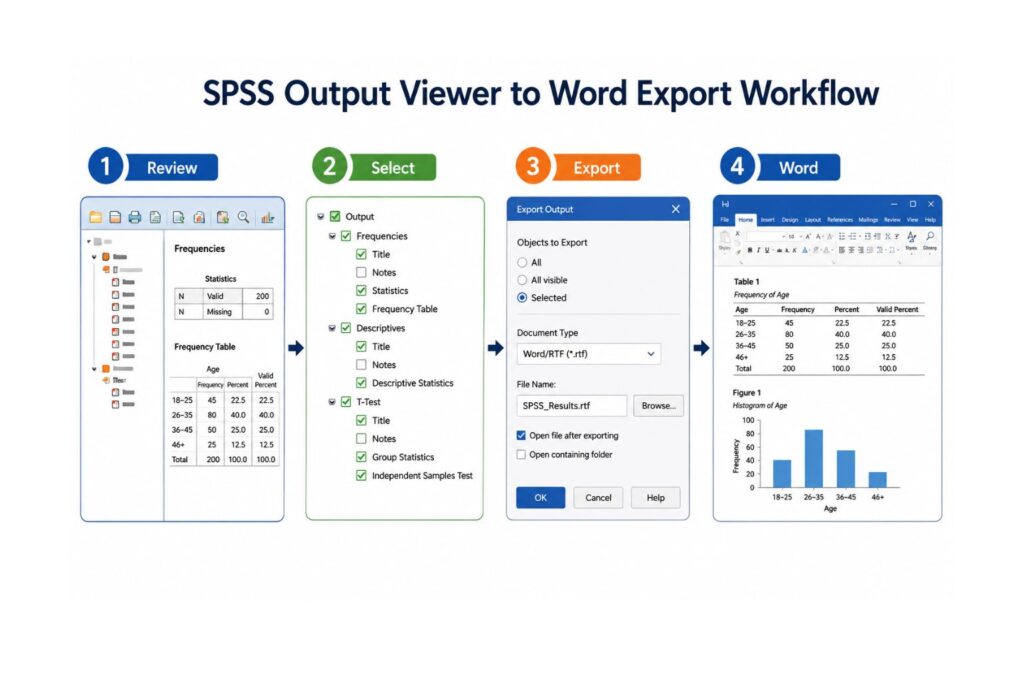

How to Do Binomial Test in SPSS
Understanding how to perform a binomial test in SPSS is essential for researchers working with categorical data, especially when the goal is to test proportions. Whether you are analyzing survey responses, clinical outcomes, or behavioral data, the binomial test provides a simple yet powerful way to determine whether the observed proportion of a binary outcome significantly differs from a hypothesized value.
In academic research, especially at dissertation level, choosing the correct statistical test is not just about running SPSS. It is about understanding the logic, ensuring correct data preparation, and interpreting results in a way that meets examiner expectations. This guide is designed to help you achieve all three while aligning with best practices used in professional statistical consulting.
If you need expert support at any point, you can Request Quotes Now through our specialists at SPSSDissertationHelp.com, where we assist students with advanced statistical analysis and dissertation writing.
What Is a Binomial Test?
A binomial test is a non-parametric statistical test used to determine whether the proportion of a binary outcome differs significantly from a specified value. It focuses on variables that contain only two possible outcomes, making it one of the simplest yet most effective tests in statistical analysis.
In practical terms, the binomial test answers questions about proportions. For example, a researcher may want to know whether more than half of respondents prefer a particular product, whether a treatment success rate exceeds a benchmark, or whether responses are evenly split between two options.
Because of its simplicity and precision, the binomial test is widely used in social sciences, healthcare research, business studies, and behavioral analysis. It is especially valuable when working with small samples or when assumptions required for parametric tests are not met.
When Should You Use a Binomial Test?
Selecting the correct test is critical in research. The binomial test is appropriate only under specific conditions, and using it incorrectly can weaken your findings.
The test should be used when your dependent variable is binary, meaning it contains exactly two categories such as yes and no, success and failure, or male and female. Each observation must be independent, meaning one participant’s response does not influence another’s. Additionally, you must have a clear hypothesized proportion to compare against your observed data.
In research practice, the binomial test is commonly applied across several scenarios. Within healthcare, it is used to evaluate treatment success rates, while in marketing it helps determine customer preferences between two products. Educational research often relies on it to assess pass and fail rates, and in the social sciences it is frequently used to analyze survey responses.
If your dataset contains more than two categories, then the binomial test is no longer appropriate. In such cases, you should consider alternatives like Chi-square analysis in SPSS, which is designed for multi-category variables.
Understanding the Logic Behind the Binomial Test
Before running the test in SPSS, it is important to understand the statistical reasoning behind it. The binomial test compares the observed proportion in your sample with a hypothesized proportion to determine whether the difference between them is statistically significant.
For example, suppose you expect that 50 percent of customers will prefer a particular service. After collecting your data, you find that 70 percent actually prefer it. The binomial test evaluates whether this difference between 50 percent and 70 percent is large enough to be considered statistically significant or whether it could have occurred by chance.
The test works by calculating the probability of observing your results under the assumption that the null hypothesis is true. If this probability is very low, typically below 0.05, the null hypothesis is rejected. This logic forms the foundation of hypothesis testing and is essential for writing strong dissertation results.
Preparing Your Data in SPSS
Data preparation is one of the most important steps in statistical analysis. Even a simple test like the binomial test can produce incorrect results if the data is not properly structured.
To begin, your dataset must include a variable that represents the binary outcome you want to analyze. Each row should represent a single observation, and the values should clearly indicate the two categories.
For example, a dataset might include a column labeled “Preference” with values such as Yes and No. However, SPSS works more effectively when these categories are coded numerically. Therefore, it is recommended to assign values such as 1 for Yes and 0 for No, or 1 for Success and 2 for Failure.
In SPSS, you should also define value labels in the Variable View. This allows the output to display meaningful category names instead of just numbers, making interpretation easier and more professional.
Proper data preparation not only ensures accuracy but also improves the quality of your analysis and reporting.
Step-by-Step: How to Do Binomial Test in SPSS
Running a binomial test in SPSS is straightforward once your data is ready. The process involves selecting the correct menu options and specifying the parameters of your test.
First, open your dataset in SPSS and ensure that your binary variable is correctly coded. Then, navigate to the top menu and click on Analyze. From there, select Nonparametric Tests, followed by Legacy Dialogs, and then choose Binomial.
Once the binomial test window appears, move your binary variable into the Test Variable List. Next, enter the test proportion, which represents your hypothesized value. For example, if you are testing whether the proportion is equal to 50 percent, you would enter 0.5.
You must also specify which category represents the “success” outcome. This is important because SPSS calculates the test based on that category.
After setting these parameters, click OK to run the test. SPSS will then generate the output, which includes the observed counts, expected proportion, and significance value.
Introduction to SPSS Output
After running the binomial test, SPSS produces output that includes several important components. Understanding these elements is essential for accurate interpretation.
The output typically shows the frequency of each category, the test proportion, and the exact significance value, which is the p-value. The p-value is the most important part of the output because it determines whether your result is statistically significant.
If the p-value is less than 0.05, the result is considered statistically significant, meaning that the observed proportion differs from the expected proportion. If the p-value is greater than or equal to 0.05, the result is not significant, and the null hypothesis cannot be rejected.
This interpretation forms the basis of your results section in a dissertation or research paper.
Example: Binomial Test in Practice
To make the concept clearer, consider a simple example. A researcher wants to determine whether students prefer online learning over traditional classroom learning.
The data shows that 65 students prefer online learning, while 35 prefer classroom learning. The researcher expects the proportion to be evenly split at 50 percent.
After running the binomial test in SPSS, the p-value is found to be 0.02. Since this value is less than 0.05, the result is statistically significant. This means that the proportion of students who prefer online learning is significantly different from 50 percent.
Such findings can then be discussed in relation to the research objectives and existing literature.
Common Mistakes to Avoid
Despite its simplicity, the binomial test is often misused by students. One common mistake is applying the test to variables with more than two categories. This leads to incorrect conclusions and should be avoided.
Another frequent issue is improper coding of variables. If the categories are not clearly defined, SPSS may produce misleading results. It is also important to ensure that the hypothesized proportion is logically justified and based on theory or prior research.
Misinterpreting the p-value is another common error. A significant result indicates a difference, but it does not imply causation. Researchers must be careful to interpret results within the context of their study.
How the Binomial Test Fits Into Your Research
The binomial test is rarely used in isolation. In most research studies, it is part of a broader analytical framework that includes multiple statistical techniques.
For example, researchers often begin with descriptive statistics to summarize their data. This may be followed by a binomial test to examine proportions, and then more advanced analyses such as regression.
To strengthen your research, you may also need support with related methods such as SPSS data analysis help, dissertation statistics help, or working with a hire statistician for dissertation expert.
Integrating the binomial test into a well-structured analysis improves both the quality and credibility of your research.
Advanced Insight: Exact Nature of the Binomial Test
One of the key advantages of the binomial test is that it is an exact test. Unlike many statistical methods that rely on approximations, the binomial test calculates exact probabilities based on the binomial distribution.
This makes it particularly useful for small sample sizes, where approximate methods may not be reliable. It also means that the test does not require assumptions about normality, making it more flexible than many parametric tests.
Because of these strengths, the binomial test is widely used in fields such as clinical research, pilot studies, and exploratory analysis.
Reporting Binomial Test Results in APA Style
In academic writing, it is important to report statistical results clearly and professionally. The binomial test should be presented in a way that is easy to understand and aligned with APA guidelines.
A typical report should include the sample size, observed proportion, expected proportion, p-value, and a brief interpretation of the results. The language should be formal and precise, avoiding unnecessary complexity.
When You Should Not Use a Binomial Test
While the binomial test is useful, it is not always the correct choice. It should not be used when your data includes more than two categories, when the variable is continuous, or when observations are dependent.
In such cases, alternative methods such as chi-square tests or regression analysis may be more appropriate.
Mid-Guide Support
At this stage, many students begin to encounter challenges related to coding variables, selecting the correct test proportion, and interpreting SPSS output accurately.
If you want expert guidance tailored to your dataset and research objectives, you can Request Quotes Now and get professional support from our team at SPSSDissertationHelp.com, specializing in dissertation-level statistical analysis.
Why the Binomial Test Matters for Dissertation Research
The binomial test plays an important role in academic research because it provides a clear and statistically sound method for testing proportions. It is easy to apply, does not require complex assumptions, and produces results that are straightforward to interpret.
For dissertation students, this test is often used in the results chapter to support hypotheses and provide evidence for research findings. When used correctly, it strengthens the overall quality of the study and demonstrates a solid understanding of statistical methods.
Deep Interpretation of Binomial Test Output
Once SPSS generates the results, your role as a researcher is to translate the output into meaningful conclusions.
The binomial test output typically includes the observed frequencies for each category, the test proportion, and the exact significance value (p-value). While the table itself is simple, the interpretation must be precise.
The first step is to identify the observed proportion of your “success” category. This is calculated by dividing the number of cases in that category by the total sample size. For example, if 65 out of 100 respondents selected “Yes,” then the observed proportion is 0.65.
Next, compare this observed proportion with your hypothesized proportion. If your expected value is 0.50, then the test evaluates whether 0.65 is significantly different from 0.50.
The most critical part of the output is the p-value. If the p-value is less than 0.05, the difference is statistically significant, and you reject the null hypothesis. If it is greater than or equal to 0.05, you fail to reject the null hypothesis.
However, interpretation should go beyond stating significance. You must explain what the result means in the context of your research question.
Turning SPSS Output into Academic Language
One of the biggest gaps in student work is converting SPSS output into well-written academic results. Examiners expect clarity, precision, and logical flow.
A strong interpretation should include the purpose of the test, the observed proportion, the expected proportion, the p-value, and a clear conclusion.
A binomial test was conducted to determine whether the proportion of participants who preferred Product A differed from the hypothesized value of 0.50. The results indicated that 65% of participants preferred Product A, which was significantly higher than the expected proportion, p = .02. Therefore, the null hypothesis was rejected, suggesting a significant preference among participants.
This level of clarity is what distinguishes professional analysis from basic output reporting.
Linking Results to Research Objectives
Your analysis should never exist in isolation. Every statistical result must connect back to your research questions or hypotheses.
For example, if your study aims to examine customer preference, the binomial test result should directly address whether that preference is statistically significant.
This is where many dissertations lose marks. Students often present results without explaining their implications. A strong dissertation not only presents findings but also interprets them in relation to theory, literature, and practical relevance.
To strengthen your work, you can integrate binomial testing with broader analytical approaches such as SPSS data analysis help, dissertation data analysis help, and advanced methods like logistic regression analysis.
Combining Binomial Test with Other Statistical Methods
In real research, the binomial test is rarely used alone. It is often part of a multi-step analytical process that provides deeper insights.
A typical research workflow may include descriptive statistics to summarize the data, followed by a binomial test to examine proportions, and then more advanced techniques such as chi-square analysis or regression.
For example, you might first identify that 70% of respondents prefer a product, then use a binomial test to determine whether this differs from 50%, and finally apply regression analysis to understand what factors influence that preference.
This layered approach strengthens your research and makes your findings more robust and credible.
Advanced Application: Real Dissertation Scenario
Consider a study examining whether employees prefer remote work over office work.
The dataset shows that 80 out of 120 employees prefer remote work. This gives an observed proportion of approximately 0.67. The researcher hypothesizes that the proportion should be 0.50.
After running the binomial test in SPSS, the p-value is 0.01. Since this is less than 0.05, the result is statistically significant.
In a dissertation, this would be interpreted as evidence that employees significantly prefer remote work over office work. This finding could then be linked to existing literature on workplace flexibility and employee satisfaction.
Such applications demonstrate how a simple statistical test can provide meaningful insights when properly interpreted.
Visual Presentation of Results
Although the binomial test itself does not require visualization, presenting your results visually can enhance clarity and impact.
You can create bar charts or pie charts in SPSS to illustrate the distribution of your categories. For example, a bar chart comparing observed and expected proportions can make your findings easier to understand for readers.
Visual elements are particularly useful in dissertations because they improve readability and demonstrate professionalism.
Common Errors in Dissertation-Level Analysis
Even when students correctly run the test, errors often occur in interpretation and reporting.
One common mistake is confusing the binomial test with the chi-square test. The binomial test is strictly for two categories, while chi-square is used for three or more.
Another issue is selecting an inappropriate hypothesized proportion. This value should always be justified based on theory, prior research, or logical reasoning.
Students also frequently report results without interpretation. Simply stating that p is less than 0.05 is not enough. You must explain what that means in the context of your study.
Finally, weak academic writing can reduce the quality of otherwise correct analysis. Clear, structured, and formal language is essential.
Examiner Expectations for Binomial Test Analysis
Examiners assess your work based on several criteria. They expect you to choose the correct test, apply it accurately, interpret the results correctly, and present your findings clearly.
They are not impressed by complex output alone. What matters is your ability to explain what the results mean and how they contribute to your research objectives.
A strong binomial test section demonstrates understanding of statistical concepts, correct application of SPSS, clear and logical interpretation, and a direct connection to research questions.
Meeting these expectations significantly improves your chances of achieving high grades.
Final CTA
If you want your binomial test results to be accurate, clearly interpreted, and fully aligned with dissertation standards, you can Request Quotes Now at SPSSDissertationHelp.com.
Our experts support you with complete SPSS analysis, Chapter 4 writing and interpretation, dissertation statistics consulting, and end-to-end research support.
Frequently Asked Questions (FAQ)
What is a binomial test in SPSS used for?
It is used to determine whether the proportion of a binary outcome differs significantly from a hypothesized value.
When should I use a binomial test instead of chi-square?
Use a binomial test when your variable has only two categories. Use chi-square when there are three or more categories.
What does the p-value indicate in a binomial test?
The p-value shows whether the difference between the observed and expected proportions is statistically significant.
Can I use a binomial test for small samples?
Yes, the binomial test is particularly suitable for small sample sizes because it is an exact test.
How do I report binomial test results in a dissertation?
Include the observed proportion, expected proportion, p-value, and a clear interpretation linked to your research question.
Is the binomial test parametric or non-parametric?
It is a non-parametric test because it does not rely on assumptions of normal distribution.
What happens if my data has more than two categories?
You should use a chi-square test instead of a binomial test.
Do I need SPSS to perform a binomial test?
No, but SPSS simplifies the process and is widely accepted in academic research.
What is the null hypothesis in a binomial test?
The null hypothesis states that the observed proportion is equal to the expected proportion.
Can binomial test results be used in publications?
Yes, when properly conducted and reported, binomial test results are acceptable in academic publications.