

Many students and researchers collect data successfully but become stuck when they reach the SPSS analysis stage. They may have clear research questions, hypotheses, survey responses, or dissertation data, but they are unsure which statistical test to use, how to clean the dataset, how to interpret SPSS output, or how to write the results correctly in Chapter 4. This is where SPSS Consulting Services become useful.
SPSS can produce many tables, charts, p-values, confidence intervals, coefficients, assumption tests, model summaries, and significance results. However, the software does not automatically explain which table matters, whether the test was correct, how to report the result in APA style, or how to connect the finding back to the research question. A student may run regression but not understand the coefficients table. Another may run ANOVA but feel confused about post hoc tests. A dissertation student may have non-significant findings and not know how to explain them without making false claims.
Our SPSS dissertation help service supports students and researchers who need expert guidance with SPSS data analysis, statistical test selection, SPSS output interpretation, APA results tables, and Chapter 4 reporting. Whether you need full dissertation data analysis or targeted help with one SPSS problem, our SPSS consultants can help you turn raw data into clear, accurate, dissertation-ready results.
What Are SPSS Consulting Services?
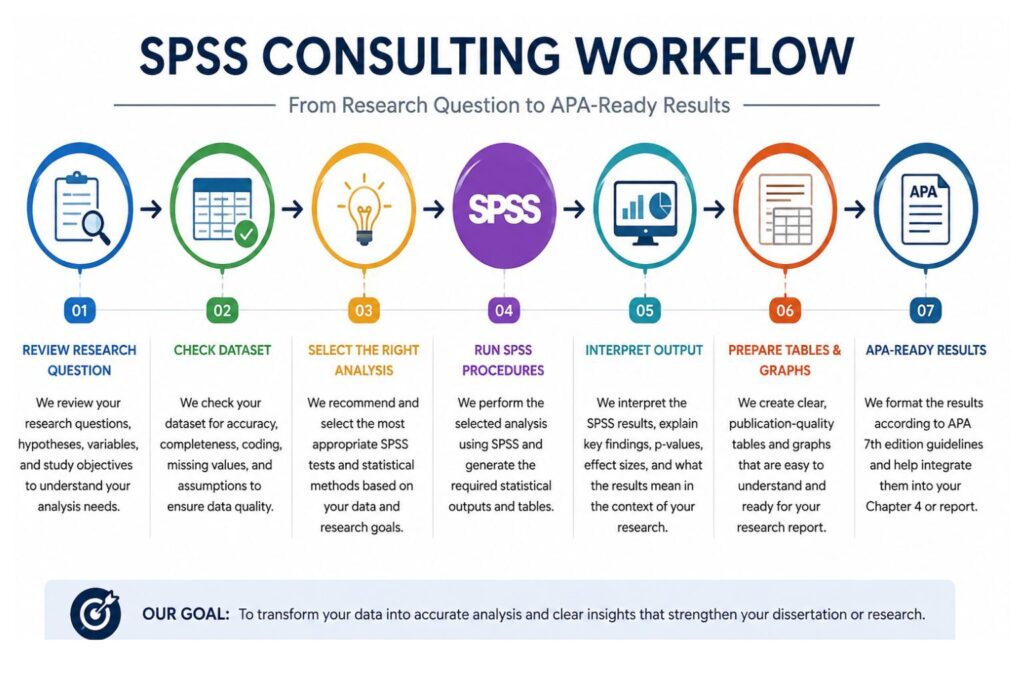
SPSS consulting services help students, researchers, and professionals plan, run, interpret, and report statistical analysis using IBM SPSS Statistics. An SPSS consultant can help you prepare your dataset, choose the correct statistical test, run SPSS procedures, interpret output tables, create APA-style results tables, and write clear findings for a dissertation, thesis, capstone, research paper, survey project, assignment, or professional report.
SPSS consulting is useful when you are not sure which test fits your research question, when your SPSS output is confusing, when your supervisor asks for corrections, or when you need help presenting results in Chapter 4.
Who Needs SPSS Consulting?
SPSS consulting is for students, researchers, and professionals who need help using SPSS correctly and reporting results clearly. It is especially useful when you have collected data but feel unsure about the next step.
Our SPSS consulting services support dissertation students, thesis students, PhD candidates, master’s students, DBA students, EdD students, DNP students, PsyD students, nursing students, psychology students, business students, education students, public health students, social science researchers, survey researchers, and professionals preparing data-based reports.
You may need SPSS consulting if you have a dataset but do not know how to analyze it. You may also need help if you already ran SPSS but do not understand the output. Some students only need help selecting one test. Others need full support from data cleaning to Chapter 4 results writing.
SPSS consulting is also useful if your supervisor, chair, or committee has asked you to revise your analysis. A consultant can review the feedback, identify what needs to change, and help you correct the analysis or reporting.
What Our SPSS Consulting Services Include
Our SPSS consulting services cover the full data analysis process. We help you move from unclear data and confusing SPSS output to organized results that match your research questions, hypotheses, and methodology.
Our support may include research question review, hypothesis review, variable review, dataset cleaning, missing data checking, coding and recoding variables, scale scoring, reliability analysis, descriptive statistics, demographic tables, frequency tables, assumption testing, statistical test selection, SPSS data analysis, SPSS output interpretation, APA table formatting, chart and graph preparation, Chapter 4 narrative support, supervisor feedback correction, and SPSS output export to Word.
If you need complete data analysis support, visit our SPSS data analysis help page. For broader dissertation support, see our dissertation data analysis help service.
Table 1: SPSS Consulting Services We Provide
| Consulting Need | What We Help With | Common SPSS Procedures | Typical Deliverable |
|---|---|---|---|
| Dataset preparation | Cleaning, coding, labels, missing values | Variable View, Recode, Compute | Clean SPSS dataset |
| Demographic analysis | Age, gender, education, group summaries | Frequencies, Descriptives | Demographic table |
| Descriptive statistics | Mean, SD, minimum, maximum, frequencies | Descriptives, Frequencies, Explore | Summary statistics table |
| Reliability analysis | Internal consistency of scales | Cronbach’s alpha | Reliability table and explanation |
| Group comparison tests | Comparing means or categories | t-test, ANOVA, chi-square | Test output and interpretation |
| Relationship testing | Testing associations between variables | Correlation, regression | Results table and narrative |
| Regression analysis | Predicting outcomes from variables | Linear or logistic regression | Model summary, coefficients, interpretation |
| Survey data analysis | Likert scales, survey scoring, response patterns | Frequencies, Descriptives, Reliability | Survey results summary |
| Output interpretation | Explaining SPSS tables and p-values | All procedures | Clear interpretation notes |
| APA results reporting | Formatting tables and writing results | Word and APA table formatting | APA-ready tables and text |
| Chapter 4 support | Organizing results by research question | Full SPSS workflow | Chapter 4 results section |
| Supervisor revision support | Fixing analysis or reporting comments | Depends on feedback | Revised results and explanations |
SPSS Consulting for Dissertation and Thesis Students
Dissertation and thesis students often need more than a one-time statistical test. They need alignment between the research questions, hypotheses, variables, methodology, statistical tests, SPSS output, and written results.
A dissertation can become weak if the analysis does not match the methodology. For example, a student may use correlation when regression is needed, use ANOVA without checking assumptions, report descriptive statistics without answering the research questions, or paste raw SPSS output into Chapter 4 without interpretation. SPSS consulting helps prevent these problems by connecting the analysis plan to the study design.
Our SPSS dissertation consulting can help with Chapter 3 methodology alignment, Chapter 4 results structure, matching tests to research questions, reporting assumption tests, explaining statistical significance, explaining non-significant findings, avoiding overstatement of results, preparing tables for committee review, and responding to supervisor or committee feedback.
If you already have SPSS output but do not understand it, you can still request help. We can review the output, identify the correct tables, explain the findings, and help you report the results clearly. For full results writing support, visit our dissertation results help page.
SPSS Data Analysis Consulting
SPSS data analysis consulting focuses on turning raw data into meaningful findings. The goal is not only to run tests. The goal is to choose the right analysis, check assumptions, interpret the output, and report findings accurately.
SPSS is widely used in social sciences, nursing, public health, psychology, education, business, and survey research. IBM provides official SPSS Statistics documentation, but many students still need practical help applying SPSS procedures to their own research questions, dissertation requirements, and supervisor instructions.
Our SPSS data analysis consulting may include choosing tests based on variable type, checking assumptions, running analyses, interpreting output, explaining what results mean, preparing tables and figures, and identifying problems in the dataset.
Common SPSS tests and procedures include frequencies, descriptive statistics, chi-square, independent samples t-test, paired samples t-test, one-way ANOVA, repeated measures ANOVA, correlation, simple linear regression, multiple regression, logistic regression, reliability analysis, factor analysis, and non-parametric tests.
For specific support, see our pages on regression analysis help, ANOVA help, reliability analysis help, SPSS, and frequency analysis in SPSS.
Table 2: Common SPSS Tests and When Consulting Helps
| SPSS Test or Procedure | When It Is Used | Where Students Often Get Stuck | Consulting Support Provided |
|---|---|---|---|
| Frequencies | Summarizing categorical variables | Percent vs valid percent | Clean frequency tables and explanation |
| Descriptive statistics | Summarizing continuous variables | Mean, SD, skewness, missing values | Descriptive tables and reporting |
| Chi-square test | Testing association between categorical variables | Expected counts and interpretation | Test setup and results explanation |
| Independent samples t-test | Comparing two independent groups | Assumptions and Levene’s test | Correct interpretation and APA write-up |
| Paired samples t-test | Comparing pre-test and post-test scores | Pairing variables correctly | Pre-post analysis and reporting |
| One-way ANOVA | Comparing three or more groups | Post hoc tests and assumption checks | ANOVA table and interpretation |
| Correlation | Testing relationship between continuous variables | Direction, strength, and p-values | Correlation matrix and explanation |
| Multiple regression | Predicting an outcome from multiple predictors | Model fit, coefficients, assumptions | Regression output interpretation |
| Logistic regression | Predicting categorical outcomes | Odds ratios and model classification | Logistic regression reporting |
| Reliability analysis | Testing scale consistency | Cronbach’s alpha interpretation | Reliability table and scale decision |
| Factor analysis | Identifying latent structure | Factor loadings and extraction choices | Factor table and interpretation |
| Non-parametric tests | Analyzing non-normal or ordinal data | Choosing the correct alternative test | Test selection and reporting |
SPSS Statistical Consulting for Test Selection
Choosing the wrong statistical test is one of the most common SPSS problems. A test should not be selected because it is familiar, simple, or commonly used by other students. The correct test depends on the research question, hypothesis, dependent variable, independent variable, measurement level, number of groups, sample structure, study design, and statistical assumptions.
An SPSS consultant can help you decide based on the research question, hypothesis, dependent variable type, independent variable type, number of groups, measurement level, normality, independence, sample size, study design, and whether the data involve repeated or independent measures.
For example, if your research question asks whether mean anxiety scores differ between two independent groups, an independent samples t-test may be appropriate. If the same participants complete anxiety scores before and after an intervention, a paired samples t-test may be more suitable. If the outcome is categorical, a different method may be needed.
Blindly choosing a test can lead to incorrect conclusions. SPSS consulting helps ensure that your analysis matches your research design before results are written in Chapter 4.
SPSS Output Interpretation Consulting
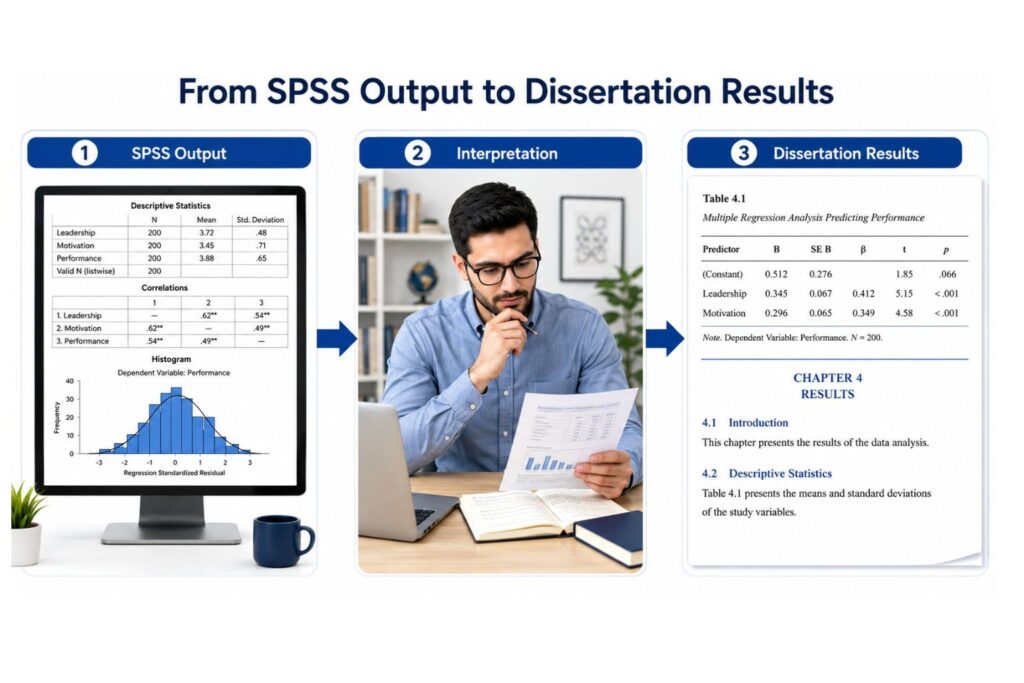
Many students can run SPSS but cannot interpret the output. SPSS may produce several tables for one test, and not every table belongs in the final results chapter. For example, regression output may include Model Summary, ANOVA, Coefficients, residual statistics, collinearity diagnostics, and charts. Students often do not know which table answers the research question.
SPSS output interpretation consulting helps explain p-values, confidence intervals, means and standard deviations, correlation coefficients, regression coefficients, odds ratios, ANOVA F values, t-test values, chi-square values, Cronbach’s alpha, factor loadings, model fit, and effect sizes.
A p-value tells you whether a result is statistically significant under the test assumptions, but it does not automatically show importance or practical meaning. For example, a statistically significant correlation may still be weak. A non-significant result may still be important to discuss if it answers the research question.
For more detailed guidance, see our page on how to interpret SPSS output.
SPSS APA Results Reporting
SPSS consulting should not stop at output. Students also need to report findings in a clear academic format. Raw SPSS output is often too crowded for a dissertation, thesis, or manuscript. Tables may have too many columns, unnecessary decimals, default titles, and formatting that does not match APA expectations.
APA Style provides guidance on presenting tables and figures clearly, including table structure, titles, notes, and readability. See the official APA Style tables and figures guidance for more detail.
Our SPSS APA results reporting support may include APA 7th edition table formatting, table titles, table notes, statistical notation, correct p-value reporting, effect size reporting, avoiding raw SPSS screenshots, integrating tables into Chapter 4, and writing concise results paragraphs.
For step-by-step support, see our guide on how to report SPSS results in APA format.
Table 3: Raw SPSS Output vs APA-Ready Results
| Area | Raw SPSS Output | APA-Ready Result | Why It Matters |
|---|---|---|---|
| Table title | Default SPSS label | Clear academic title | Helps readers understand the result |
| Decimal places | Often inconsistent | Consistent decimals | Improves readability |
| p-values | Shown in SPSS format | Reported according to APA style | Prevents unclear reporting |
| Effect sizes | May be absent or separate | Included when needed | Shows practical importance |
| Assumption results | Multiple raw tables | Summarized clearly | Avoids clutter |
| Regression coefficients | Full coefficients output | Clean coefficient table | Focuses on key predictors |
| Charts | Default SPSS charts | Edited, labeled figures | Improves presentation |
| Interpretation | Not provided by SPSS | Written explanation | Connects results to research questions |
| Chapter 4 placement | Unorganized output | Structured by research question | Helps examiners follow the results |
SPSS Consulting for Survey Data Analysis
Many SPSS consulting projects involve survey data. Survey analysis can be confusing because students must handle demographic variables, Likert-scale items, missing responses, reverse-coded questions, scale scores, reliability analysis, and hypothesis testing.
Our SPSS consulting for survey data analysis may include Likert-scale coding, reverse coding, composite score creation, reliability analysis, demographic summaries, descriptive statistics, hypothesis testing, survey tables, response pattern checks, missing data review, and results reporting.
For example, if a questionnaire has five items measuring job satisfaction, the items may need to be checked for reliability before creating a composite satisfaction score. If some items are reverse coded, they must be recoded correctly before analysis. If this step is ignored, the results may be misleading.
For full survey support, visit our survey data analysis services page.
SPSS Consulting for Common Problems
Students often request SPSS consulting after something goes wrong. Sometimes the dataset does not open correctly. Sometimes variables are coded incorrectly. Sometimes the supervisor says the wrong test was used. In other cases, the student ran the analysis but does not understand why the findings are non-significant.
Common SPSS problems include dataset not opening correctly, variables coded incorrectly, Likert items not scored correctly, missing values not declared, wrong statistical test selected, SPSS output too large, assumptions not checked, supervisor requests for different analysis, non-significant p-values, confusing regression output, poorly formatted APA tables, and weak Chapter 4 interpretation.
SPSS consulting helps identify the cause of the problem and provide a practical solution. Sometimes the solution is simple, such as recoding a variable or using Valid Percent instead of Percent. Other times, the analysis plan may need deeper revision.
Table 4: Common SPSS Consulting Problems and Solutions
| Problem | Likely Cause | Consulting Solution | Final Deliverable |
|---|---|---|---|
| Wrong test selected | Test not matched to research question | Review variables and hypotheses | Correct analysis plan |
| Messy dataset | Unclean codes, labels, or missing values | Clean and prepare dataset | Clean SPSS file |
| Missing values | Missing data not defined properly | Check and label missing values | Missing data summary |
| Likert scale scoring issue | Reverse items or scale scores not handled | Recode and compute scale scores | Correct scale variables |
| Confusing SPSS output | Too many tables or unclear results | Identify relevant output | Interpretation notes |
| Non-significant results | Weak effect, low power, or true null result | Explain results carefully | Accurate results narrative |
| Poor APA formatting | Raw SPSS output pasted directly | Format tables and notes | APA-ready tables |
| Supervisor correction request | Method or reporting issue | Review feedback and revise | Corrected analysis/results |
| Tight deadline | Limited time for analysis and writing | Prioritize required tasks | Fast consulting support |
| Chapter 4 writing problem | Results not organized by question | Structure findings clearly | Chapter 4 results draft |
Pricing: How Much Do SPSS Consulting Services Cost?
The cost of SPSS consulting services depends on the scope of the project. A small task, such as interpreting one SPSS output table, usually costs less than full dissertation data analysis. A complete Chapter 4 project costs more because it may involve dataset cleaning, test selection, analysis, tables, interpretation, and written results.
Pricing depends on the project level, number of research questions, number of variables, dataset cleanliness, type of analysis, number of tests, whether APA tables are needed, whether interpretation is needed, whether Chapter 4 writing is included, urgency, deadline, and supervisor revision scope.
Simple SPSS consulting tasks usually cost less than full dissertation data analysis because they may involve only test selection, output interpretation, or one statistical procedure. Full Chapter 4 support costs more because it may include data cleaning, analysis, tables, interpretation, and results writing. Short deadlines may also increase the cost.
Request a quote now and share your dataset, research questions, deadline, and instructions so we can give you accurate pricing.
Why Choose SPSSDissertationHelp.com?
SPSSDissertationHelp.com focuses on dissertation-centered SPSS consulting for students and researchers. Unlike general analytics support, our service is designed around academic research needs, including research questions, hypotheses, Chapter 3 methodology, Chapter 4 results, APA reporting, and supervisor feedback.
Students choose us because we provide dissertation-focused SPSS consulting, support for students and researchers, confidential data handling, clear communication, custom analysis based on research questions, APA-ready tables and results, no unrealistic grade promises, support for revisions and supervisor feedback, and assistance for undergraduate, master’s, PhD, DBA, EdD, DNP, PsyD, nursing, psychology, business, education, public health, and social science projects.
Our goal is to help students understand and present their data responsibly. We do not fabricate data, invent findings, or promise guaranteed grades. We help you analyze your actual dataset and report the results clearly.
Our SPSS Consulting Process
Our process is designed to make SPSS consulting clear, organized, and easy to follow.
- Submit your research questions, dataset, and instructions.
Send your topic, variables, research questions, hypotheses, university guidelines, and deadline. - We review your variables, methodology, and analysis needs.
We check whether your dataset and research questions align with the proposed analysis. - We recommend the right SPSS analysis plan.
We identify suitable SPSS tests based on your design and variables. - We clean or prepare the dataset where needed.
This may include coding, recoding, labels, missing values, scale scoring, or variable computation. - We run the approved SPSS procedures.
The analysis is performed according to your research questions and instructions. - We interpret the output and prepare tables.
We identify the important output and explain what it means. - We help format results for APA or Chapter 4.
Results are organized into clear tables and written explanations. - You review the results and request clarifications if needed.
If your supervisor asks for changes, we can help revise the analysis or explanation.
When Should You Hire an SPSS Consultant?
You can hire an SPSS consultant at different stages of your research project. The best time is often before running the analysis, but many students seek help after collecting data or after receiving supervisor feedback.
You may need an SPSS consultant before collecting data, before choosing tests, after collecting messy data, after receiving supervisor feedback, before submitting Chapter 4, when SPSS output is confusing, when p-values are not significant, when assumptions fail, when tables need APA formatting, or when the deadline is close.
Hiring an SPSS consultant early can prevent mistakes. However, it is also possible to request help later if you already have output and need interpretation or corrections.
Ethical SPSS Consulting Support
SPSS consulting should support learning, accuracy, and responsible reporting. It should not be used to fabricate results, change findings, or misrepresent data. Ethical consulting helps students understand their data, choose appropriate methods, and report findings honestly.
Our SPSS consulting support is based on actual datasets, real research questions, accurate statistical procedures, transparent interpretation, responsible reporting, institutional guidelines, no fabricated data, no false findings, and no guaranteed grades.
Students should review the results, ask questions, and make sure they understand the analysis before submission. Ethical SPSS consulting helps students strengthen their research while respecting academic integrity.
FAQs About SPSS Consulting Services
SPSS consulting services help students and researchers plan, run, interpret, and report statistical analysis using SPSS. Services may include dataset review, test selection, SPSS analysis, output interpretation, APA tables, and Chapter 4 results writing.
Yes. An SPSS consultant can review your research questions, hypotheses, variables, sample structure, and methodology to recommend the correct statistical test.
Yes. We help dissertation students with SPSS data cleaning, statistical analysis, output interpretation, APA results tables, and Chapter 4 writing.
Yes. We can explain SPSS output tables, p-values, coefficients, confidence intervals, model summaries, effect sizes, assumption tests, and statistical conclusions.
Yes. We can help organize Chapter 4 results by research question or hypothesis, prepare tables, explain findings, and write clear results narratives.
Yes. We can format SPSS results into APA-style tables with clear titles, consistent decimals, table notes, and correct statistical reporting.
Yes. We can review supervisor feedback, identify the issue, revise the analysis or reporting, and help prepare corrected results.
Yes. We help with Likert-scale coding, reverse coding, composite scores, reliability analysis, demographic tables, descriptive statistics, and survey hypothesis testing.
Yes. We help with common SPSS tests including regression, ANOVA, chi-square, t-tests, correlation, reliability analysis, factor analysis, and non-parametric tests.
The cost depends on the number of variables, tests, research questions, dataset condition, deadline, and whether you need APA tables or Chapter 4 writing. Request a quote for accurate pricing.
Turnaround depends on the project size and deadline. Small interpretation or test-selection tasks may be faster than full dissertation analysis or Chapter 4 support.
Yes, SPSS consulting is ethical when it supports accurate analysis, responsible reporting, and student understanding. It should not involve fabricated data, false results, or guaranteed grades.
Yes. You can request help with one test, one output table, one supervisor comment, or one section of Chapter 4.
Send your dataset, research questions, hypotheses, methodology section if available, supervisor instructions, required test list, deadline, and any SPSS output you already have.
Conclusion
SPSS Consulting Services help students and researchers avoid wrong tests, confusing output, poor APA formatting, and weak Chapter 4 results. A strong SPSS analysis requires more than clicking menus. It requires clear research questions, correct test selection, clean data, accurate interpretation, and professional reporting.
Whether you need help choosing a test, analyzing survey data, interpreting SPSS output, formatting APA tables, or writing dissertation results, our consultants can guide you through the process.
If you need SPSS Consulting Services for dissertation data analysis, test selection, output interpretation, APA results tables, or Chapter 4 writing, contact SPSSDissertationHelp.com today. Share your research questions, dataset, deadline, and instructions, and our SPSS consultants will help you turn your data into clear, accurate, dissertation-ready results.